
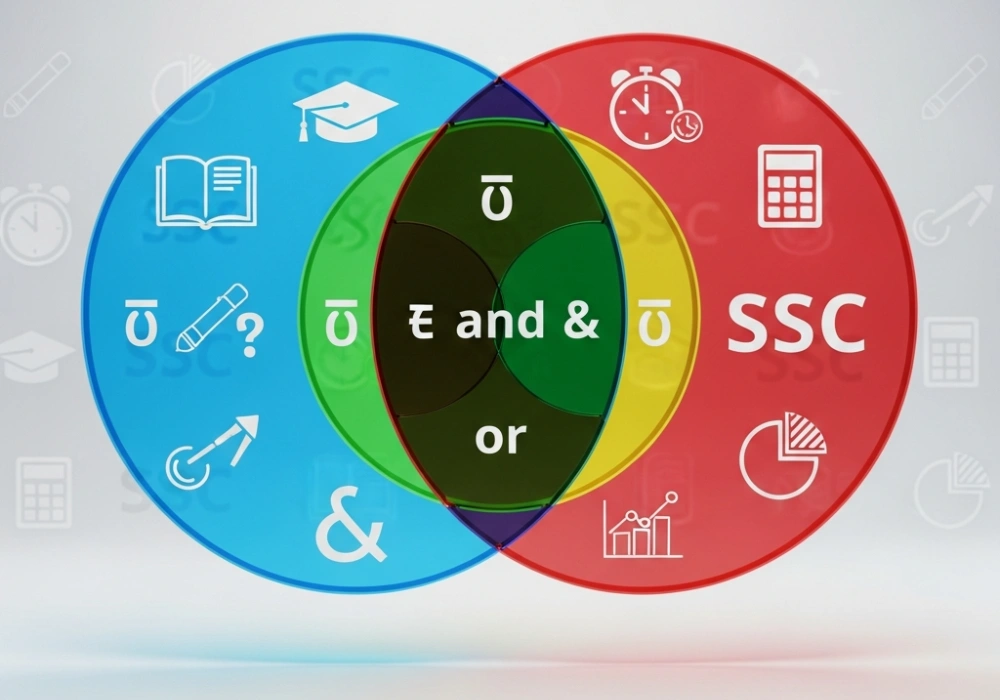
The Vital Role of Venn Diagrams in SSC Competitive Exams
Venn Diagrams represent one of the most scoring and conceptually significant topics in the General Intelligence and Reasoning section of various SSC examinations, including CGL, CHSL, MTS, and CPO. At its core, the study of Venn Diagrams is about understanding the logical relationships between different groups, classes, or sets of items. In the high-pressure environment of a competitive exam, the ability to quickly visualize how different categories intersect, overlap, or remain distinct is a hallmark of a sharp logical mind. These questions test your cognitive ability to categorize information and recognize hierarchies or shared characteristics. Mastering this topic not only guarantees a handful of marks but also improves your overall analytical speed, allowing you to dedicate more time to complex mathematical problems. This mock test has been meticulously designed by our experts at myentrance.in to cover the entire spectrum of Venn Diagram logic, from simple categorical relationships to complex overlapping three-set problems. By engaging with these 20 challenging questions and reading the deep-dive explanations provided, you will develop a foolproof strategy to tackle any Venn-related problem the SSC might throw at you. Let us embark on this journey to logical excellence!
Venn Diagram Practice Questions
- Question 1: Which of the following diagrams correctly represents the relationship between: Men, Fathers, and Doctors?
A) Three disjoint circles.
B) One circle inside another, with a third circle intersecting both.
C) One circle inside another, and a third circle completely separate.
D) Three circles intersecting each other in a chain. - Question 2: Identify the diagram that best illustrates the relationship among: Fruits, Apples, and Vegetables.
A) Two separate circles inside a larger circle.
B) One circle inside another circle, and a third circle entirely separate.
C) Three concentric circles.
D) Three partially overlapping circles. - Question 3: Which diagram represents: Mammals, Cows, and Crows?
A) Two separate circles inside a larger circle.
B) One circle inside another, and a third separate circle.
C) Three disjoint circles.
D) All three circles overlapping. - Question 4: Choose the correct representation for: Engineers, Human Beings, and Rats.
A) One circle inside another, and a third separate circle.
B) Two circles inside one large circle.
C) Three intersecting circles.
D) One circle inside another, with the third circle intersecting only the outer one. - Question 5: Which diagram depicts: Seconds, Minutes, and Hours?
A) Three concentric circles.
B) Three separate circles.
C) Three intersecting circles.
D) Two intersecting circles inside a large circle. - Question 6: Identify the relationship: Metal, Iron, and Chlorine.
A) One circle inside another, and a third separate circle.
B) Three separate circles.
C) Two circles inside a larger circle.
D) Three intersecting circles. - Question 7: Represent the logic for: Furniture, Chairs, and Tables.
A) Two separate circles inside a larger circle.
B) One circle inside another, inside another.
C) Three overlapping circles.
D) Two intersecting circles inside a larger circle. - Question 8: Choose the best diagram for: Week, Day, and Year.
A) Three concentric circles.
B) Three disjoint circles.
C) Three partially overlapping circles.
D) Two circles inside a larger circle but separate from each other. - Question 9: Which diagram shows: Police, Thieves, and Criminals?
A) One circle inside another, and a third separate circle.
B) One circle inside another, with the third circle intersecting both.
C) All three circles are disjoint.
D) Two circles inside a larger circle. - Question 10: Relationship between: Biology, Zoology, and Physics.
A) One circle inside another, and a third separate circle.
B) Three separate circles.
C) Two circles inside a larger circle.
D) Three intersecting circles. - Question 11: Which diagram represents: School, Classroom, and Blackboard?
A) Three concentric circles.
B) Three separate circles.
C) Two circles inside a large circle.
D) One circle intersecting two others. - Question 12: Logic for: Birds, Parrots, and Bats.
A) One circle inside another, and a third separate circle.
B) Two circles inside a larger circle.
C) Three separate circles.
D) Three intersecting circles. - Question 13: Represent: Oceans, Pacific Ocean, and Atlantic Ocean.
A) Two separate circles inside a larger circle.
B) Three concentric circles.
C) Three disjoint circles.
D) Three intersecting circles. - Question 14: Which diagram represents: Quadrilaterals, Squares, and Rectangles?
A) One circle inside another, which is inside a third circle.
B) Two separate circles inside a large circle.
C) Three intersecting circles.
D) Two intersecting circles inside a large circle. - Question 15: Choose the correct representation: Musicians, Men, and Women.
A) One circle intersecting two separate circles.
B) Three separate circles.
C) Three concentric circles.
D) Two circles inside a larger circle. - Question 16: Relationship between: Stationery, Pens, and Pencils.
A) Two separate circles inside a larger circle.
B) Three concentric circles.
C) Three intersecting circles.
D) One circle inside another, with a third separate. - Question 17: Logic for: Food, Curd, and Spoons.
A) One circle inside another, and a third separate circle.
B) Two circles inside a larger circle.
C) Three separate circles.
D) Three intersecting circles. - Question 18: Represent: Tall men, Black haired people, and Indians.
A) Three partially overlapping circles.
B) Three concentric circles.
C) Two circles inside a large circle.
D) Three separate circles. - Question 19: Logic for: Sun, Planets, and Earth.
A) One circle inside another, and a third separate circle.
B) Three separate circles.
C) Two circles inside a larger circle.
D) Three concentric circles. - Question 20: Relationship between: Liquids, Milk, and Water.
A) Two separate circles inside a larger circle.
B) Three concentric circles.
C) Three separate circles.
D) Three intersecting circles.
Answer Key & Explanations
Click to view Detailed Explanations
1. Answer: B – Every father is a man, so the ‘Fathers’ circle must be entirely contained within the ‘Men’ circle. However, doctors can be fathers, they can be men who are not fathers, and they can also be women. Thus, the ‘Doctor’ circle must intersect both the ‘Fathers’ and ‘Men’ circles, while also having a part outside of them to represent female doctors.
2. Answer: B – Apples are a specific type of fruit, so the ‘Apples’ circle must be inside the ‘Fruits’ circle. Vegetables are a completely different category of food item and have no logical intersection with fruits or apples in a biological sense. Thus, the ‘Vegetables’ circle remains entirely separate.
3. Answer: B – Cows are mammals, meaning the ‘Cows’ circle is a subset of ‘Mammals’ and sits inside it. Crows, however, are birds and not mammals, so the ‘Crows’ circle must be drawn separately from the mammal-cow group.
4. Answer: A – All engineers are human beings, so the ‘Engineers’ circle is fully contained within the ‘Human Beings’ circle. Rats are rodents and not humans, so they form a separate circle that does not touch the other two.
5. Answer: A – This is a hierarchical relationship. Seconds make up minutes, and minutes make up hours. Therefore, the ‘Seconds’ circle is inside ‘Minutes’, which is itself inside ‘Hours’, creating three concentric circles.
6. Answer: A – Iron is a specific type of metal, placing the ‘Iron’ circle inside the ‘Metal’ circle. Chlorine is a non-metal gas, so it must be represented by a separate circle that does not overlap with the metal group.
7. Answer: A – Both chairs and tables are types of furniture. However, a chair is not a table and a table is not a chair. Therefore, both ‘Chairs’ and ‘Tables’ circles are inside the larger ‘Furniture’ circle but do not touch each other.
8. Answer: A – This follows a time-based hierarchy. Days are the components that form a week, and weeks are components that form a year. This results in three concentric circles representing the inclusion of one into the other.
9. Answer: A – All thieves are criminals, so the ‘Thieves’ circle is inside the ‘Criminals’ circle. Police officers are the ones who catch criminals and are a distinct professional group with no logical intersection with the thief/criminal set. Thus, ‘Police’ is separate.
10. Answer: B – Biology, Zoology, and Physics are all different branches of science. While Zoology is a branch of Biology (meaning Zoology should be inside Biology), Physics is an entirely separate branch of science. Looking at the options provided, if Zoology were inside Biology, B would not fit, but usually in SSC, if ‘Science’ isn’t the parent, and they list three subjects, they might be treated as distinct departments. However, logically, Zoology is inside Biology, and Physics is separate. If the options don’t reflect that, we look for the closest logic. Here, B assumes three distinct subjects of study.
11. Answer: A – A blackboard is located inside a classroom, and a classroom is located inside a school. This creates a spatial hierarchy represented by three concentric circles.
12. Answer: A – Parrots are birds, so the ‘Parrots’ circle is inside the ‘Birds’ circle. Bats, despite having wings, are mammals and not birds. Therefore, ‘Bats’ is represented by a separate circle.
13. Answer: A – The Pacific Ocean and Atlantic Ocean are both specific, distinct bodies of water that fall under the general category of ‘Oceans’. Thus, two separate circles reside within one large ‘Oceans’ circle.
14. Answer: A – This is a geometric classification. All squares are rectangles (by definition of having four right angles), and all rectangles are quadrilaterals (four-sided polygons). Thus, ‘Squares’ is inside ‘Rectangles’, which is inside ‘Quadrilaterals’.
15. Answer: A – Musicians can be men or women. Since a person is typically categorized as either a man or a woman (in standard logical sets), these two circles are separate. The ‘Musician’ circle intersects both, as some musicians are men and some are women.
16. Answer: A – Pens and pencils are both items of stationery. They are distinct from each other (a pen is not a pencil). So, two separate circles are drawn inside a larger ‘Stationery’ circle.
17. Answer: A – Curd is a type of food, so its circle is inside ‘Food’. A spoon is a utensil used to eat food but is not food itself, so ‘Spoons’ is a separate circle.
18. Answer: A – There is a partial overlap between all three. Some Indians are tall, some tall people have black hair, and some Indians have black hair. There are also people who are tall, Indian, AND have black hair. This requires three circles intersecting each other.
19. Answer: A – Earth is a planet, so ‘Earth’ is inside ‘Planets’. The Sun is a star, not a planet, so the ‘Sun’ circle is separate from the planet-earth group.
20. Answer: A – Milk and water are both distinct types of liquids. They do not overlap with each other in their pure form as categories. Thus, two separate circles are placed inside the larger ‘Liquids’ circle.
Need More Practice or Have Doubts?
Success in SSC exams requires consistent practice and expert guidance. If you found these questions challenging or need more free study materials, mock tests, and personalized mentorship, our team is here to help you 24/7!
💬 Chat with our Experts on WhatsApp (+91 9526806124)




