
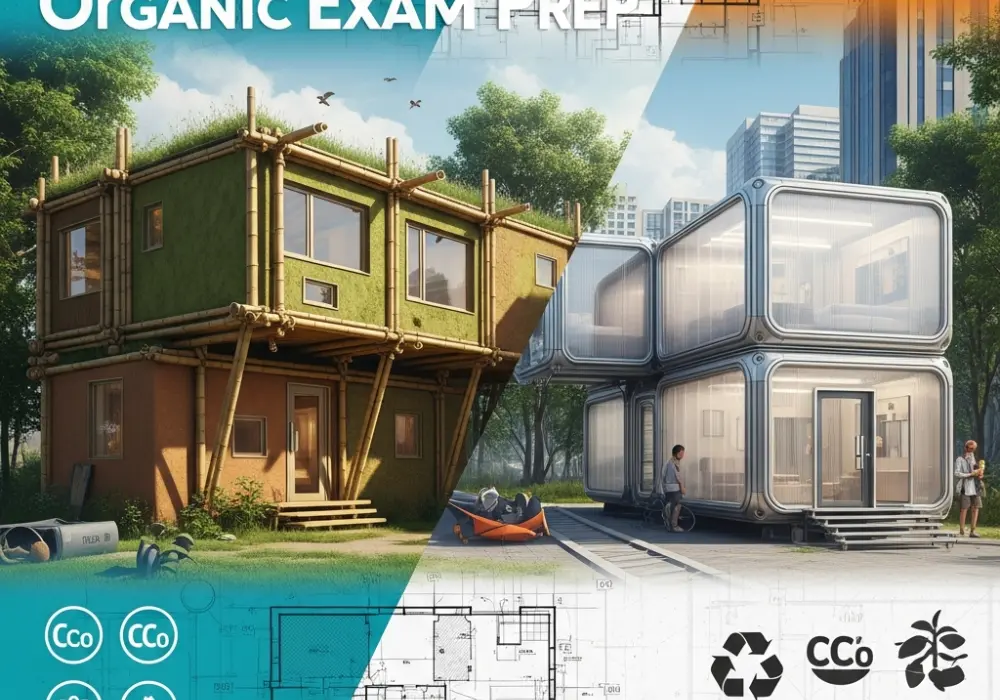
NID DAT Previous Year Questions: Mastering Environmental Sensitivity and Modular Housing Hacks
Welcome, aspiring designers, to the ultimate decoder for one of the most challenging and recurring themes in the National Institute of Design (NID) Design Aptitude Test (DAT). When we analyze the pattern of Previous Year Questions, a clear trend emerges: NID isn’t just looking for someone who can draw a pretty house; they are looking for design thinkers who understand the deep-rooted relationship between material science, ecology, and social context. Today, we are deep-diving into the Environmental Sensitivity Analysis of traditional craft materials versus industrial synthetics, specifically through the lens of sustainable modular housing.
As the world pivots toward sustainability, the modular housing industry is at a crossroads. Should we use the age-old wisdom of bamboo and mud, or the precision of 3D-printed polymers and carbon fiber? This post will provide you with five simulated questions that mirror the complexity of Previous Year Questions, along with ‘Ninja Shortcuts’ to help you solve them in the high-pressure environment of the exam hall.
Understanding the Core Conflict: Craft vs. Industry
Before we jump into the questions, let’s establish the foundation. Traditional craft materials (bamboo, cane, jute, lime, rammed earth) are often localized, carbon-neutral, and culturally significant. However, they can lack the standardization required for rapid ‘Lego-style’ modular assembly. Industrial synthetics (PVC, Polycarbonate, Glass-Reinforced Plastic, EPS Foam) offer extreme durability, lightweight properties, and precision, but they carry a heavy environmental cost through carbon emissions and non-biodegradability. NID examiners love to test your ability to balance these two worlds.
Question 1: The Disaster Relief Dilemma
Question: You are tasked with designing a rapid-deploy modular shelter for flood-hit areas in Northeast India. You must choose between locally sourced Bamboo-mat panels and pre-fabricated PVC corrugated sheets. Conduct an environmental sensitivity analysis and justify your material choice based on the ‘Cradle-to-Grave’ cycle.
The Traditional Method:
A typical student would write a long essay discussing how bamboo grows fast and PVC is plastic. They might draw a basic hut and list the pros and cons of each. This takes about 10 minutes and often lacks the analytical depth required for a top rank.
The 30-Second Ninja Shortcut: The ‘Energy-Transport-End’ Matrix
Apply the E-T-E Matrix immediately.
1. Energy: Bamboo has low embodied energy; PVC is high.
2. Transport: Bamboo is local (zero miles); PVC requires logistical fuel.
3. End: Bamboo biodegrades into the soil; PVC creates microplastics.
The Winner: Bamboo-mat panels with a minimal bio-resin coating for water resistance. This shows you understand ‘Material Hybridization’—the hallmark of a master designer.
Question 2: Thermal Regulation in Arid Climates
Question: A modular housing unit is designed for a desert environment. Compare the thermal performance and environmental impact of using ‘Thatch-Clay Composite’ panels versus ‘Expanded Polystyrene (EPS)’ insulation boards. Which is more sustainable for a long-term modular solution?
The Traditional Method:
Students focus only on the ‘cooling’ aspect. They might mention that mud is cool and plastic is hot, ignoring the fact that EPS is actually a superior insulator in terms of R-value (Thermal Resistance).
The 30-Second Ninja Shortcut: The ‘Breathability vs. Barrier’ Logic
Remember this: Natural materials are ‘Breathable’ (Passive); Synthetics are ‘Barriers’ (Active). In an arid climate, moisture regulation is as vital as heat regulation. Thatch-clay panels allow for ‘evaporative cooling’ and ‘thermal mass,’ meaning they absorb heat during the day and release it at night. EPS is a barrier that traps stale air and requires mechanical ventilation (AC). The Design Verdict: Choose Thatch-Clay for its life-cycle sustainability and passive cooling benefits, reducing the need for electricity later.
Question 3: The Joinery Challenge
Question: In a ‘Flat-pack’ modular furniture system for affordable housing, compare the sustainability of using ‘Traditional Wood-Joinery (Mortise and Tenon)’ versus ‘Nylon-6 Injection-Molded Fasteners’.
The Traditional Method:
Most candidates think wood is always better because it’s ‘natural.’ They fail to see that traditional wood joinery requires skilled labor and time, which might not be sustainable for mass modular housing.
The 30-Second Ninja Shortcut: The ‘Assembly-Disassembly (AD)’ Ratio
Sustainable design isn’t just about the material; it’s about the Utility. If the goal is ‘Modular Housing,’ then Circular Economy is the key word. Wood-joinery is beautiful but hard to mass-produce without waste. The Ninja Move: Propose a Bio-Polymer fastener. It provides the industrial precision of Nylon but the environmental sensitivity of wood. If forced to choose between the two original options, choose wood but specify ‘CNC-milled’ joinery to bridge the gap between craft and industry.
Question 4: Scalability and Waste Management
Question: Analyze the waste generated during the production of 1,000 modular units using ‘Hand-woven Rattan wall skins’ vs. ‘Vacuum-formed ABS plastic skins’. Which has a lower environmental footprint at the production stage?
The Traditional Method:
Students often get confused by the word ‘scalability.’ They think industrial machines are ‘wasteful’ and hand-weaving is ‘perfect.’ They forget about the scraps left behind in craft processes.
The 30-Second Ninja Shortcut: The ‘Closed-Loop’ Rule
Think about the scrap. Rattan scrap is compostable. ABS plastic scrap is recyclable but only if the infrastructure exists. The Ninja Insight: In the context of Previous Year Questions, NID values the ‘Social Footprint.’ Hand-weaving supports a rural economy (Social Sustainability), whereas ABS supports a factory. In NID’s philosophy, the material that supports the human element while being biodegradable is always the winner.
Question 5: Longevity and Aesthetics
Question: Modular houses often face the ‘Aesthetic Decay’ problem. Compare how a ‘Lime-plastered Hemp-crete block’ ages compared to an ‘Acrylic-coated Aluminum panel’. Which is better for a ‘Sense of Place’?
The Traditional Method:
Focusing purely on the fact that Aluminum doesn’t rust. This is a technical answer, not a design answer.
The 30-Second Ninja Shortcut: The ‘Wabi-Sabi’ vs. ‘Plastic Fatigue’ Concept
Industrial synthetics like Acrylic-coated Aluminum don’t ‘age’; they ‘fail.’ They scratch, peel, and look ugly when worn out. Traditional materials like Lime and Hemp-crete ‘patina.’ They age gracefully and can be easily patched by the resident. The Winner: Hemp-crete. It connects the dweller to the building through maintenance, fostering a sustainable psychological bond with the home.
Cheat Sheet: Quick Revision Formulas for Environmental Analysis
| Factor | Traditional Craft Materials | Industrial Synthetics | Design Verdict |
|---|---|---|---|
| Embodied Energy | Very Low (Solar/Manual) | Very High (Fossil Fuels) | Craft Wins for Carbon Neutrality |
| Thermal Mass | High (Stabilizes temp) | Low (Requires insulation) | Craft Wins for Passive Cooling |
| Recyclability | Biodegradable (Soil) | Technical Cycle (Factory) | Craft Wins for End-of-Life |
| Precision | Variable (Hand-made) | High (Micron-level) | Synthetics Win for Assembly |
| Social Impact | High (Community-based) | Low (Automated) | Craft Wins for Social Design |
Key Terms to Use in Your NID Answers:
- Biomimicry: Designing systems modeled on biological entities.
- Circular Economy: A system aimed at eliminating waste and the continual use of resources.
- Life Cycle Assessment (LCA): The systematic analysis of the environmental impact of a product during its entire life.
- Standardization vs. Customization: The balance between mass production and individual craft.
- VOCs (Volatile Organic Compounds): Toxic gases emitted by certain industrial paints and synthetics.
By mastering these comparisons, you are not just preparing for the exam; you are training your brain to think like a professional designer. Remember, in NID, there is no single ‘right’ answer, but there is always a ‘better-justified’ answer. Use these Previous Year Questions insights to frame your sketches and your text responses with logic and empathy.
🚀 Ready to Ace the NID DAT?
Don’t let complex design theories overwhelm you. Whether you need more Previous Year Questions analysis, expert feedback on your portfolio, or a structured mock test series, we are here to help you secure your seat at NID!
Get Free Guidance & Design Resources Today!
💬 Chat with our Experts on WhatsApp (+91 9526806124)




