
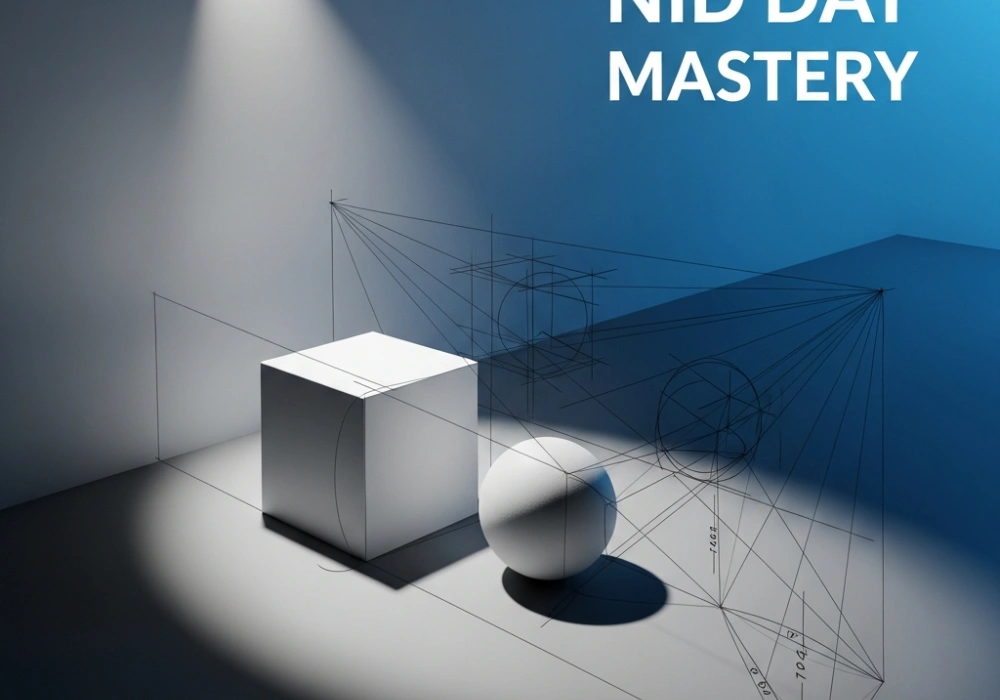
NID DAT Mastery: Visualizing Abstract Concepts and Emotions Through 3D Primitives
The National Institute of Design (NID) Design Aptitude Test (DAT) is renowned for testing more than just your sketching ability; it tests your ability to think, feel, and communicate through form. One of the most challenging recurring themes in Previous Year Questions involves the visualization of abstract concepts—such as ‘silence’, ‘betrayal’, or ‘resilience’—using nothing more than basic 3D geometric forms like spheres, cubes, cylinders, and cones. This exercise is coupled with the mastery of light and shadow play to create depth and mood. In this comprehensive guide, we will decode five simulated exam-level questions based on past trends to transform your approach from a novice to a design expert.
Understanding the Grammar of Geometry
Before we dive into the questions, we must establish the psychological language of shapes. Every primitive form carries an inherent ‘personality’. A Cube represents stability, rigidity, and perhaps boredom. A Sphere represents perfection, continuity, and softness. A Cone suggests direction, focus, or even danger if inverted. When you combine these with Light and Shadow, you add a narrative layer. High-contrast shadows evoke drama and tension, while soft, diffused shadows suggest tranquility and mystery.
Question 1: Visualizing “Systemic Oppression”
The Task: Using only cubes and one light source, represent the concept of ‘Systemic Oppression’ in a 3D space.
The Traditional Method
Most students try to draw a literal scene—perhaps many small cubes being crushed by one giant cube. While this conveys the message, it lacks the sophistication NID examiners look for. It is too literal and often lacks a strong focal point or interesting shadow play.
The 30-Second Ninja Shortcut
Focus on the negative space and the direction of the light. Place a single, tiny cube at the bottom of a narrow, towering corridor made of massive, interlocking cubes. Position the light source high above so that the shadows of the massive cubes almost completely engulf the tiny cube, leaving only a sliver of light on its top surface. This emphasizes the weight and the inescapable nature of the system.
Core Concept Deep-Dive
In this approach, you are using Scale Contrast and Chiaroscuro (the treatment of light and shade). The massive cubes are not just shapes; they are the ‘system’. The shadows they cast are the ‘oppression’. By keeping the forms primitive, you force the viewer to focus on the spatial relationship between the oppressor (the large mass) and the oppressed (the small unit).
Question 2: Visualizing “Anxiety”
The Task: Use cylinders and spheres to represent the internal state of ‘Anxiety’.
The Traditional Method
Students often draw spheres floating in a messy way or cylinders falling over. This creates a sense of ‘mess’, but not necessarily the sharp, clinical feeling of anxiety.
The 30-Second Ninja Shortcut
Use Tension through Proximity. Place several thin, tall cylinders close together, creating a claustrophobic cage. Inside, place a sphere that is slightly too large for the space, appearing wedged or stuck. Use a harsh, low-angle light source to create long, distorted, and overlapping shadows that ‘vibrate’ across the floor. The overlapping shadows mimic the racing thoughts associated with anxiety.
Core Concept Deep-Dive
Anxiety is characterized by a feeling of being trapped and overwhelmed. By using thin cylinders, you create a visual ‘staccato’. The shadows become a rhythmic pattern that feels unstable. The sphere’s lack of movement space creates a physical sensation of discomfort in the viewer, which is the hallmark of successful abstract design.
Question 3: Visualizing “Growth and Aspiration”
The Task: Use cones and light to depict ‘Growth and Aspiration’.
The Traditional Method
Drawing cones stacked like a tree or pointing upwards is the standard response. While technically correct, it is often static and lacks the ‘soul’ of aspiration.
The 30-Second Ninja Shortcut
Create a Spiral Progression. Arrange cones of increasing sizes in a spiral path that leads toward a bright light source located at the top-right corner of the frame. Ensure the ‘shadows’ of the lower cones are soft and merge into the ground, while the higher cones have sharp, crisp highlights. This suggests a journey from the unknown (darkness) to clarity (light).
Core Concept Deep-Dive
Aspiration is a movement toward an ideal. The spiral is a dynamic shape that suggests evolution. By graduating the light intensity, you tell a story of progress. The light isn’t just an illumination tool here; it represents the ‘goal’. This is a prime example of how light-shadow play defines the narrative arc in NID Previous Year Questions.
Question 4: Visualizing “Betrayal”
The Task: Use two cubes and one sphere to visualize ‘Betrayal’.
The Traditional Method
Usually, students place a cube ‘hitting’ another cube while a sphere looks on. This is narrative, but not abstract enough for a high score.
The 30-Second Ninja Shortcut
The Shadow Deception. Place two cubes side-by-side, appearing to support a sphere. However, position the light source so that the shadow cast by one cube actually appears to be ‘undermining’ or cutting into the shadow of the sphere, while the other cube remains supportive. The betrayal is hidden in the shadows, not the objects themselves.
Core Concept Deep-Dive
Betrayal is about the gap between appearance and reality. By using the shadow to tell the ‘real’ story while the physical objects look stable, you demonstrate a high level of conceptual thinking. This ‘Shadow Narrative’ technique is a powerful tool for NID DAT aspirants to differentiate their work from the thousands of other applicants.
Question 5: Visualizing “Silence”
The Task: Using a single cube in a vast space, represent ‘Silence’ through shadow play.
The Traditional Method
Drawing a cube in the middle of a blank page. It looks empty, but not necessarily ‘silent’.
The 30-Second Ninja Shortcut
The Infinite Gradient. Place a single cube off-center. Use a very distant, soft light source that creates an extremely long, fading shadow that eventually blends into a dark background. The vastness of the ‘un-lit’ space compared to the small cube creates a vacuum. The absence of complex shadows implies an absence of noise.
Core Concept Deep-Dive
Silence in visual design is often about Minimalism and Balance. By using an off-center composition (The Rule of Thirds), you create a sense of lingering. The long, fading shadow represents the echo of a sound that has finally died away. This mastery of ‘value’ (the range of grays) is crucial for the NID DAT studio test and mains exam.
Cheat Sheet: Quick Revision Formulas for Abstract Visualization
Use the table below to quickly decide your strategy during the actual examination.
| Concept Type | Recommended Primary Form | Shadow Technique | Emotional Impact |
|---|---|---|---|
| Stability/Power | Cubes / Pyramids | Short, heavy, dark shadows at the base | Grounding, immovable |
| Fragility/Grace | Spheres / Thin Cylinders | Long, soft, light-gray shadows | Delicate, ethereal |
| Conflict/Chaos | Sharp Cones / Shards | Overlapping, high-contrast, multi-directional | Aggressive, confusing |
| Solitude/Peace | Single Primitive in large void | Fading gradients, minimal contrast | Contemplative, quiet |
| Innovation/Future | Cylinders / Floating forms | Uplighting (light from below) | Unconventional, modern |
Final Pro-Tips for NID DAT Success
- Always define your light source: Before drawing, mark a small ‘X’ or sun icon outside your frame to keep your shadow angles consistent.
- Texture of shadows: Use smooth gradients for calm concepts and hatching/cross-hatching for gritty or stressful concepts.
- Composition: Avoid placing your main object exactly in the center. Use the Rule of Thirds to create more dynamic and professional-looking layouts.
Mastering these techniques requires practice. Do not just read this guide—grab a pencil and try to recreate these five scenarios. Focus on how the shadow changes as you move the imaginary light source. This spatial awareness is exactly what NID looks for in its future designers.
Ready to Ace the NID DAT?
Struggling with abstract concepts or need a professional review of your sketches? Our expert mentors at myentrance.in are here to help you crack the design entrance exams with personalized guidance and mock tests.
💬 Chat with our Experts on WhatsApp (+91 9526806124)




