
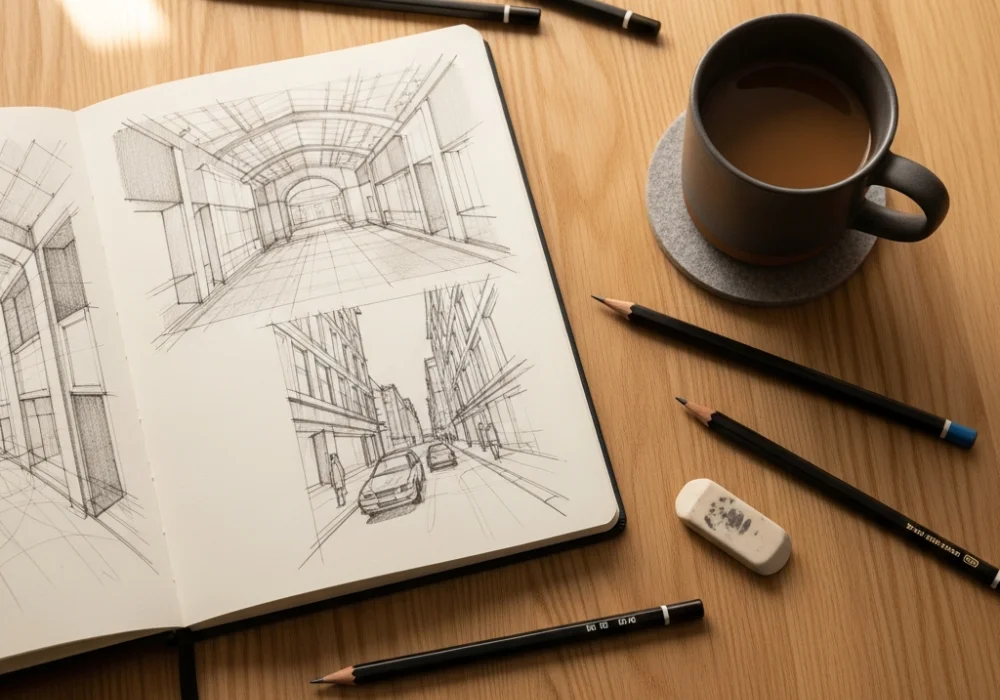
Mastering the Art of Sketching for NID DAT
The National Institute of Design (NID) Design Aptitude Test (DAT) is one of the most prestigious entrance exams for creative minds in India. While many believe that sketching is an innate talent, the truth is that it is a skill honed through consistent practice, observation, and technical understanding. For an aspirant, your sketchbook is not just a collection of drawings; it is a visual diary of your thought process. To succeed in the upcoming exams, you must move beyond simple drawing and focus on visual communication. This guide provides a detailed roadmap of daily exercises designed to elevate your sketching skills to a professional level, ensuring you stand out in the current syllabus requirements.
The Foundations of Line Quality and Hand-Eye Coordination
The first step in any design journey is mastering the basics. Line quality refers to the thickness, darkness, and smoothness of your lines. In NID DAT, a shaky or uncertain line suggests a lack of confidence. To improve this, you should dedicate 15 minutes every morning to ‘ghosting lines.’ This involves marking two points on a paper and drawing a straight line between them in one swift motion without using a ruler. Repeating this daily builds muscle memory in your shoulder and elbow rather than just your wrist.
- Scribbling and Doodling: Start with loose scribbles to warm up your hand muscles.
- Circle and Ellipse Drill: Draw rows of circles and ellipses of varying sizes, attempting to close them perfectly at the starting point.
- Pressure Control: Practice drawing lines that transition from very light to very dark using the same pencil to understand tonal values.
Understanding the World of Perspective
Perspective is the backbone of realistic drawing. The latest pattern of NID DAT often includes questions where you must visualize a scene from a specific viewpoint, such as an ant’s eye view or a bird’s eye view. Understanding 1-point, 2-point, and 3-point perspective is non-negotiable. Spend time drawing cubes and cylinders in different perspectives every day. Once you are comfortable with basic shapes, try drawing the room you are sitting in. Identify the horizon line and the vanishing points. This exercise helps in developing spatial awareness, a key trait looked for by NID examiners.
Human Anatomy and Proportional Drawing
NID DAT often requires candidates to sketch people in various activities—like a street vendor selling vegetables or a child playing with a hoop. To excel here, you must understand human proportions. A common technique is the ‘eight-head rule,’ where the total height of an adult is roughly eight times the height of their head. Practice quick gesture drawings of family members or people in a park. Focus on the ‘line of action’ to capture movement rather than fine details. Over time, your sketches will look more dynamic and less robotic.
Texture and Material Representation
A designer must be able to communicate what a product is made of through their drawing. Whether it is the cold hardness of stainless steel, the transparency of glass, or the softness of fabric, rendering textures is vital. Use daily objects as your models. Look at how light interacts with a crumpled piece of paper versus a polished spoon. In your practice sessions, try to replicate these textures using only a graphite pencil. Focus on contrast and highlights to give your sketches a three-dimensional feel.
The Importance of Composition and Storytelling
Excellent sketching skills are wasted if the composition is poor. Composition refers to how elements are arranged within the frame. Use the ‘Rule of Thirds’ to create more engaging visuals. In NID DAT, you are often asked to illustrate a story or a concept. Practice ‘thumbnailing’—creating small, quick layouts of your final drawing to see which arrangement works best. Think about the narrative: what is the focal point of your drawing? What story are you trying to tell through the objects and characters included?
A Weekly Sketching Regimen for Aspirants
Consistency is more important than the duration of practice. It is better to practice for 45 minutes daily than for five hours once a week. Below is a suggested weekly schedule to balance all aspects of sketching for the latest pattern of design entrance exams.
| Day | Primary Focus Area | Exercise Duration |
|---|---|---|
| Monday | Line Quality & Geometry | 60 Minutes |
| Tuesday | 1-Point & 2-Point Perspective | 90 Minutes |
| Wednesday | Human Anatomy & Gestures | 90 Minutes |
| Thursday | Texture & Material Rendering | 60 Minutes |
| Friday | Object Drawing from Memory | 90 Minutes |
| Saturday | Composition & Storyboarding | 120 Minutes |
| Sunday | Full-Length Mock Test Sketching | 3 Hours |
Why Mock Tests on myentrance.in are Critical
While daily exercises build your technical skills, performing under the pressure of a ticking clock is a different challenge altogether. This is where myentrance.in becomes your best ally. We offer a wide range of mock tests that simulate the actual exam environment of NID DAT and NIFT GAT. By taking these tests, you can assess your speed, identify your weak areas, and learn how to manage your time effectively between the theory and drawing sections. Our study materials are curated by experts to align with the latest pattern, ensuring you are always ahead of the competition. Regular practice with our mock tests will transform your sketching from good to exam-ready.
Frequently Asked Questions (FAQ)
How many hours should I practice sketching daily for NID DAT?
Consistency is key. Ideally, you should spend at least 1.5 to 2 hours daily focusing on different aspects like perspective, anatomy, and creative thinking. On weekends, try to simulate exam conditions by solving full-length papers from myentrance.in.
Which pencils are best for the NID DAT drawing section?
For the exam, a range of high-quality graphite pencils (HB, 2B, 4B, and 6B) is usually sufficient. Avoid using too many mechanical pencils for shading, as they can lead to scratchy textures. Stick to professional-grade brands for better pigment and wood quality.
Is it necessary to use color in the NID DAT exam?
The instructions in the question paper will specify if color is required. Generally, it is good to be proficient with pencil colors or dry pastels. However, many successful candidates ace the exam using only graphite pencils to show light, shadow, and depth.
Can I clear NID DAT if I am not an ‘artist’?
NID is not looking for fine artists; they are looking for designers. A designer is a problem solver. If you can communicate your ideas clearly, maintain correct proportions, and show a logical thought process through your sketches, you have a high chance of success.
How do I improve my sketching speed?
Speed comes with confidence. The ghosting technique and gesture drawing exercises mentioned above are specifically designed to reduce hesitation. Also, taking regular mock tests on platforms like myentrance.in will help you understand how to allocate time for each question.
Ready to Ace Your Design Entrance?
Get expert guidance, specialized study materials, and access to premium mock tests for NID DAT and NIFT. Don’t leave your success to chance—start your journey with myentrance.in today!
💬 Chat with our Experts on WhatsApp (+91 9526806124)




