
The Significance of Static GK in Competitive Exams
Static General Knowledge (GK) forms the bedrock of most competitive entrance examinations in India. Whether you are an aspirant for the NID DAT, NIFT GAT, SSC, or Kerala PSC, the weightage given to Indian Geography and History remains consistently high. Unlike current affairs, which change daily, Static GK provides a stable foundation of facts that, once mastered, guarantee high accuracy and quick marks in the general awareness section. At myentrance.in, we provide specialized mock tests designed to help you navigate the latest pattern of these exams with ease.
The Blueprint of Indian Geography
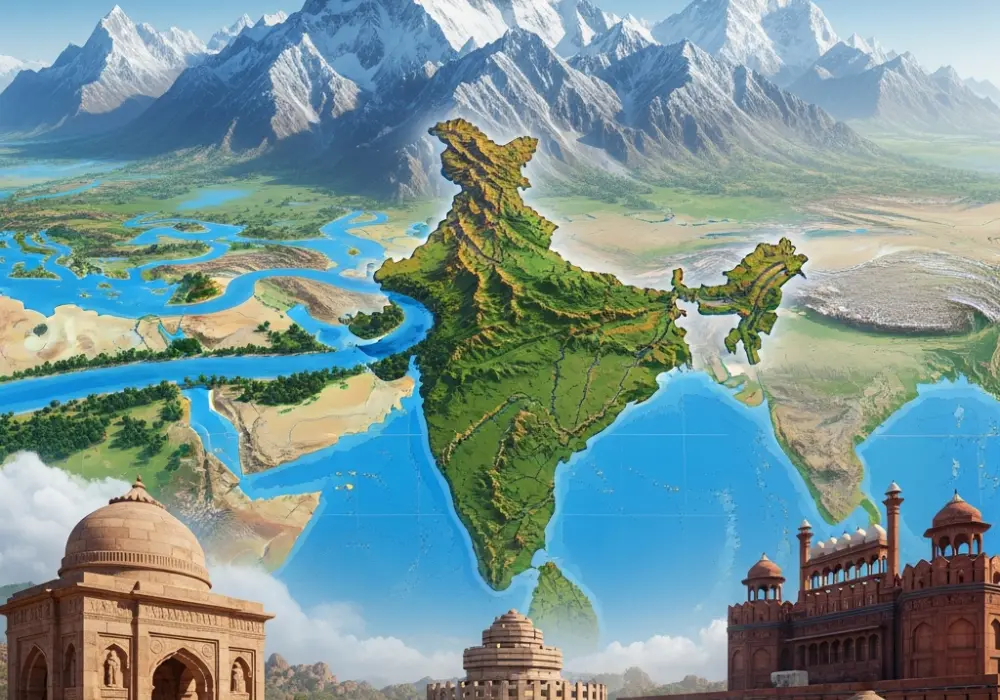
Indian Geography is a vast subject that covers the physical, social, and economic landscape of the country. To excel in the upcoming exams, candidates must focus on the physiographic divisions of India. The country is broadly divided into six physiographic regions: The Northern Mountains (Himalayas), the Indo-Gangetic Plains, the Peninsular Plateau, the Indian Desert, the Coastal Plains, and the Islands.
Key Rivers and Their Origins
Rivers are often the most frequently asked topic in geography sections. Understanding the drainage systems—both Himalayan and Peninsular—is crucial. The Ganga, Brahmaputra, and Indus are the lifelines of the north, while the Godavari, Krishna, and Kaveri dominate the south. For those preparing for the Kerala PSC, detailed knowledge of the Periyar and Bharathappuzha is mandatory.
| Physical Feature / Peak | Range / Location | Significance |
|---|---|---|
| Kanchenjunga | Sikkim (Himalayas) | Highest peak located within Indian territory |
| Anamudi | Western Ghats (Kerala) | Highest peak in South India |
| Majuli Island | Brahmaputra River | Largest river island in the world |
| Sundarbans | West Bengal | World’s largest mangrove forest |
Climate and Vegetation
The Indian monsoon system is a complex yet vital topic. Aspirants should understand the Southwest Monsoon and the Northeast Monsoon, along with the distribution of forests. Tropical Evergreen, Deciduous, and Montane forests are the primary types found across the subcontinent. Mastery over these topics through regular practice on myentrance.in will ensure you don’t lose marks on these predictable questions.
Crucial Facts on Indian History
Indian History is typically categorized into Ancient, Medieval, and Modern periods. Each segment requires a different strategic approach to memorize names, dates, and events without confusion.
The Ancient Era: From Indus Valley to Gupta Empire
The Indus Valley Civilization (IVC) is the starting point of Indian history. Candidates must know the major sites like Harappa, Mohenjo-Daro, and Lothal, along with their unique characteristics such as urban planning and drainage. Following the IVC, the Vedic period, the rise of Mahajanapadas, and the Mauryan Empire under Ashoka the Great are pivotal topics. The Gupta Empire, often referred to as the ‘Golden Age’ of India, is another area where examiners focus on literature, science, and art.
The Medieval Era: Dynasties and Culture
Medieval history covers the period from the Delhi Sultanate to the Mughal Empire. The architectural contributions of the Mughals, the administrative reforms of Sher Shah Suri, and the Bhakti and Sufi movements are essential sub-topics. For students aiming for NID and NIFT, the aesthetic and cultural history of these periods can even overlap with design-related questions.
The Modern Era: The Freedom Struggle
This is perhaps the most significant section for competitive exams. The establishment of the British East India Company, the Revolt of 1857, and the subsequent rise of the Indian National Congress (INC) form the core. Key figures like Mahatma Gandhi, Subhash Chandra Bose, and Sardar Vallabhbhai Patel, and movements like Non-Cooperation, Civil Disobedience, and Quit India are frequently tested. Practicing mock tests on myentrance.in that focus on these historical timelines will significantly enhance your retention.
Strategic Preparation for Static GK
- Visual Learning: Use maps to memorize the locations of national parks, biosphere reserves, and mountain passes.
- Mnemonics: Create short phrases to remember the order of dynasties or the states through which the Tropic of Cancer passes.
- Daily Practice: Dedicate at least 30 minutes to Static GK every day.
- Mock Tests: Regularly attempt specialized GK quizzes and full-length mock tests on myentrance.in to stay updated with the latest pattern.
Frequently Asked Questions (FAQ)
What are the most important topics in Indian Geography?
The most important topics include the Himalayan system, river drainage systems, national parks, wildlife sanctuaries, and India’s international borders.
How can I prepare for History for the NIFT GAT?
Focus on Modern Indian History and the cultural/artistic contributions of ancient and medieval dynasties, as these are often integrated into the GAT syllabus.
Where can I find free mock tests for Static GK?
You can access high-quality mock tests for NID, NIFT, SSC, and Kerala PSC on the portal myentrance.in, which offers material based on the current syllabus.





