
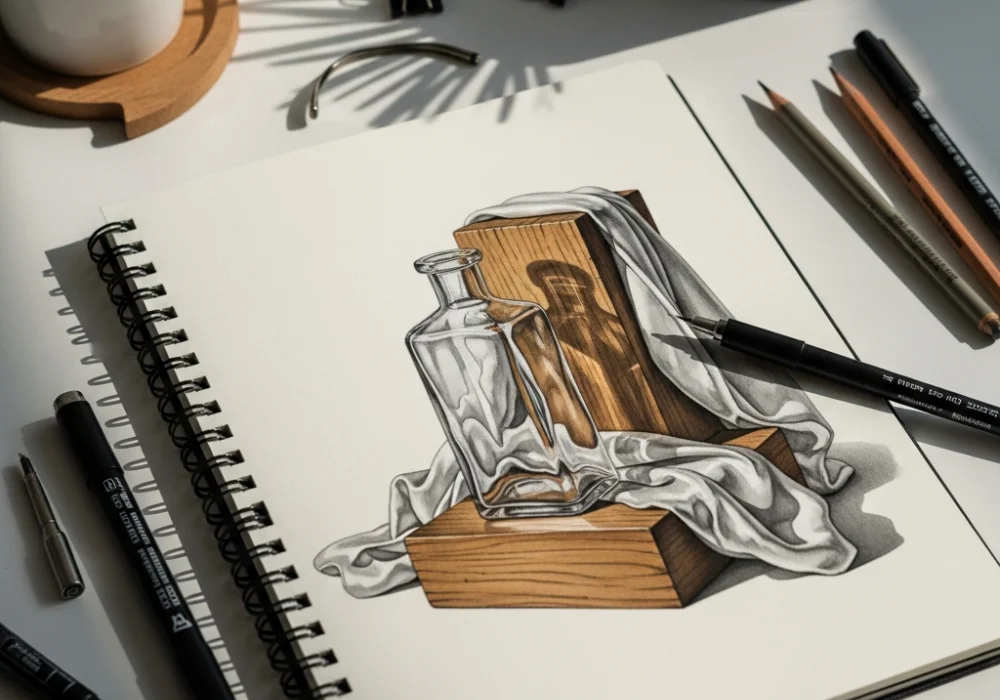
Elevating Your Creative Ability Test (CAT) Performance
For aspirants eyeing a seat at the National Institute of Fashion Technology, the Creative Ability Test (CAT) is the ultimate canvas to showcase their potential. While most candidates focus on basic sketching and coloring, the difference between an average score and a top rank often lies in the mastery of textures and form. In the latest pattern of the NIFT entrance exam, evaluators are not just looking for a neat drawing; they are looking for a designer’s eye—the ability to translate the physical world onto a 2D surface with depth, realism, and tactile quality.
Moving Beyond Basic Sketching: The Power of Texture
Texture refers to the surface quality of an artwork. In the NIFT context, you might be asked to design a product, a garment, or a space using specific materials. If you draw a wooden chair and it looks like plastic, you lose marks on material handling. To master textures, you must understand the interplay of light and shadow. Whether it is the roughness of jute or the sheen of silk, every material interacts with light differently.
- Visual Texture: Creating the illusion of a texture through lines, dots, and shading.
- Tactile Representation: Making the viewer ‘feel’ the material through your rendering style.
- Material Honesty: Using the right medium (pencil, markers, or dry pastels) to mimic the actual properties of the object.
Techniques for Rendering Diverse Materials
To excel in the current syllabus requirements, students must practice rendering various surfaces. Below is a comparative guide on how to approach common materials found in NIFT exam questions:
| Material Type | Key Rendering Technique | Visual Characteristics |
|---|---|---|
| Polished Metal | High Contrast Shading | Sharp highlights, dark shadows, and reflected shapes. |
| Natural Wood | Organic Grain Lines | Varying line weights, knots, and matte shading. |
| Transparent Glass | Minimalist Contours | Refractions, soft edges, and faint highlights. |
| Woven Fabric | Hatching & Cross-hatching | Repetitive patterns following the drape and fold of the cloth. |
| Rough Stone | Stippling & Scumbling | Irregular dots and circular motions to show porosity. |
Understanding Form and Three-Dimensionality
Form is the 3D version of a shape. In NIFT drawings, ‘flat’ drawings are a common pitfall. To master form, you must utilize value scales. A value scale ranges from the darkest black to the lightest white. By applying these values strategically, you can transform a circle into a sphere or a square into a cube. This is essential for product design questions where you must demonstrate how a product occupies space.
Key elements of form include:
- Highlight: The area where the light source hits directly.
- Core Shadow: The darkest part of the object away from the light.
- Reflected Light: Light bouncing off the floor back onto the object.
- Cast Shadow: The shadow the object throws onto the surface it sits on.
The Role of Perspective in Design Drawing
A deep understanding of one-point, two-point, and three-point perspective is non-negotiable for upcoming exams. When you render textures on a surface that is receding into the distance, the texture itself must follow the perspective rules. For example, the weave of a carpet should appear smaller and denser as it moves toward the horizon line. This level of detail shows the examiners that you possess a sophisticated understanding of spatial dynamics.
Strategic Practice with Mock Tests
Theoretical knowledge is only half the battle. To truly refine your drawing techniques, you need consistent practice under timed conditions. This is where myentrance.in becomes an invaluable resource. By practicing with our specialized mock tests, you can simulate the NIFT exam environment. Our mock tests provide diverse prompts that challenge your ability to render complex textures and innovative forms, ensuring you are well-prepared for any surprise in the actual paper.
Expert Tips for NIFT CAT Success
1. Observe Reality: Spend time looking at different fabrics and objects around your house. Notice how light falls on a velvet cushion versus a ceramic cup. 2. Control Your Pencil: Practice varying the pressure of your pencil. Soft pressure for highlights and firm pressure for deep shadows. 3. Stay Clean: In NIFT, presentation matters. Avoid smudging your work; use a piece of paper under your hand to protect your drawing. 4. Time Management: Don’t spend too much time on one texture. Allocate specific minutes for sketching, shading, and detailing.
Frequently Asked Questions (FAQ)
What are the most common materials to render in NIFT?
Common materials include wood, metal, plastic, glass, and various fabric types like denim, silk, and wool. Mastering these will cover most product and fashion-based questions.
How can I improve my 3D drawing skills for NIFT?
Focus on learning perspective and understanding the five elements of light and shadow. Practicing with real-life objects (still life) is the best way to improve your 3D perception.
Are color pencils or markers better for the NIFT CAT?
It depends on your comfort level. Color pencils are great for blending and subtle textures, while markers are excellent for bold, vibrant industrial designs. Most toppers use a combination of both.
Where can I find sample papers for the NIFT design exam?
You can find comprehensive mock tests and study materials tailored for the latest pattern on myentrance.in to help you refine your skills and track your progress.





