
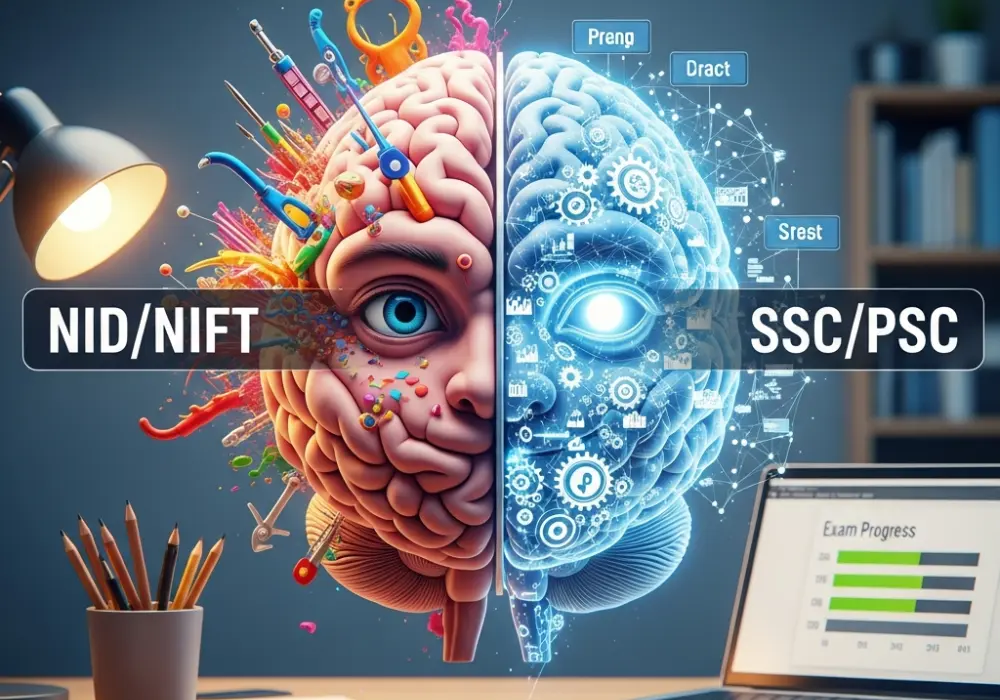
The Science of Success: Why Cognitive Skills Matter
In the competitive landscape of modern entrance examinations, rote learning is no longer sufficient. Whether you are aiming for a creative career through the NID DAT or NIFT GAT, or seeking a stable government position via SSC and Kerala PSC, the core differentiator between success and failure is often cognitive agility. Cognitive skills represent the brain’s ability to process, analyze, and retain information efficiently. By focusing on cross-domain preparation, students can develop a versatile mental toolkit that applies to both artistic and analytical challenges.
Key Cognitive Domains for Modern Aspirants
Competitive exams today are designed to test various facets of the human intellect. While the syllabus may differ, the underlying cognitive requirements often overlap. Here are the primary domains you must master:
- Spatial Reasoning: Essential for Design exams like NID and NIFT, where you must visualize 3D objects from 2D sketches.
- Logical Deduction: A staple for SSC and Kerala PSC exams, requiring the ability to find patterns and draw conclusions from complex data.
- Quantitative Aptitude: The ability to manipulate numbers and solve mathematical problems under pressure, a common requirement across all major competitive tests.
- Verbal Processing: Mastering language syntax and comprehension, which is vital for both descriptive design papers and objective government exam sections.
Comparing Cognitive Demands: Design vs. Government Exams
Understanding the intersection between different exam types can help you streamline your preparation. The following table highlights how cognitive demands manifest across various upcoming exams.
| Skill Category | Design Exams (NID, NIFT) | Govt Exams (SSC, Kerala PSC) |
|---|---|---|
| Visualization | High: Requires creating perspective and shadow. | Moderate: Limited to non-verbal reasoning patterns. |
| Data Interpretation | Moderate: Understanding consumer trends. | High: Analyzing complex graphs and statistics. |
| Time Management | Focus on finishing creative layouts. | Focus on speed and accuracy for MCQ responses. |
| Critical Thinking | Subjective problem-solving for design issues. | Objective logic based on set rules and syllogisms. |
The Cross-Domain Advantage: Why Preparation Overlaps
Many students believe that preparing for a Design exam is completely different from preparing for a Government exam. However, the latest patterns show a convergence. For instance, the general awareness section of the NIFT GAT shares a similar foundation with the general knowledge requirements of Kerala PSC exams. Similarly, the logical reasoning found in SSC tests can significantly sharpen the analytical mind needed for the NID DAT’s Part A. By training in multiple domains, you build a neural plasticity that makes you more adaptable to unexpected question formats.
Practical Strategies to Boost Your Mental Performance
Enhancing your cognitive skills requires a disciplined approach. Here are actionable steps to integrate into your daily study routine:
- Daily Mental Exercises: Solve puzzles like Sudoku or Rubik’s cubes to improve pattern recognition and spatial awareness.
- Active Recall: Instead of re-reading notes, test yourself frequently. This strengthens memory pathways.
- Timed Practice: Speed is the ultimate decider. Use the latest pattern mock tests to simulate real exam conditions.
- Diverse Reading: Read everything from design journals to administrative reports to build a wide-ranging vocabulary and general awareness.
The Role of Systematic Practice with MyEntrance.in
No matter how much you read, cognitive skills are only sharpened through application. This is where myentrance.in becomes your most valuable asset. Our platform offers meticulously curated mock tests for NID DAT, NIFT GAT, Kerala PSC, and SSC. These tests are designed based on the current syllabus and latest patterns to ensure that your preparation remains relevant and rigorous. By regularly engaging with our study material, you can track your progress, identify cognitive bottlenecks, and refine your exam strategy before the big day.
Integrating Brain Health into Your Study Plan
Cognitive success isn’t just about books; it’s about biology. To maintain peak mental performance, ensure you are prioritizing sleep, which is critical for memory consolidation. Stay hydrated and incorporate physical exercise to increase blood flow to the brain. A healthy mind is more capable of handling the stress and cognitive load of upcoming exams.
Frequently Asked Questions
How do cognitive skills help in Design exams?
Cognitive skills like spatial visualization and creative problem-solving are essential for NID and NIFT to translate abstract ideas into concrete visual designs effectively.
Can I prepare for SSC and Design exams simultaneously?
Yes. While the specialized sections differ, the foundation of logical reasoning, quantitative aptitude, and English comprehension is common across both domains.
Why are mock tests important for cognitive development?
Mock tests, such as those provided by myentrance.in, help in developing ‘test-taking stamina’ and improving the speed of cognitive processing under a time limit.
What is the best way to improve logical reasoning for Kerala PSC?
Consistency is key. Practice a wide variety of puzzles and use latest pattern mock tests to understand the specific logic used in current PSC question formats.





