
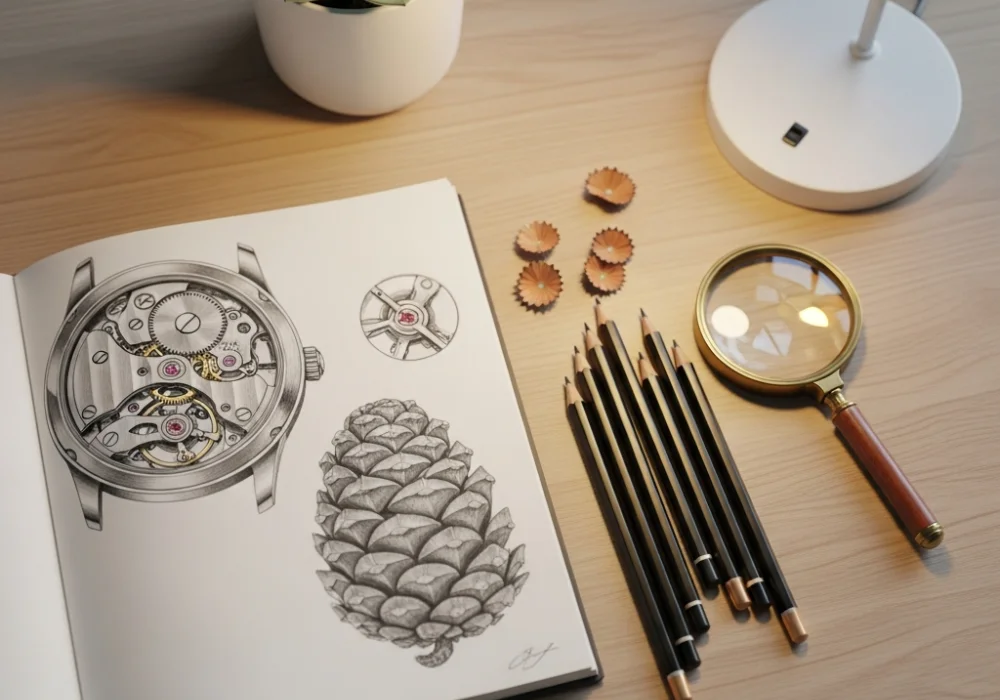
The Importance of Observation in NID DAT
The National Institute of Design (NID) Design Aptitude Test (DAT) is widely regarded as one of the most challenging entrance exams for aspiring designers. While many candidates focus solely on their sketching abilities, the true core of the NID assessment lies in ‘Observation Skills’. This doesn’t simply mean looking at an object; it means seeing its proportions, understanding its mechanics, and interpreting its relationship with the surrounding environment. In the upcoming cycle, the demand for deeper analytical thinking is expected to rise. To succeed, students must transition from basic drawing to advanced visual analysis.
Why Observation is the Designer’s Greatest Tool
Design is essentially problem-solving. To solve a problem, you must first observe it. In the NID DAT, observation questions often test your ability to recall everyday details that most people overlook. Whether it is the number of spokes on a bicycle wheel, the way a specific leaf connects to its stem, or the sequence of buttons on a remote control, your ability to document these details accurately is what sets you apart. Advanced observation involves sensory integration, where you use not just your eyes, but your understanding of touch, weight, and function to represent an object on paper.
Advanced Strategies to Enhance Your Observation
1. The Method of Negative Space Mastery
Instead of focusing on the object itself, try focusing on the space around it. This technique, often used by professional artists, helps in achieving perfect proportions without getting distracted by the object’s labels. When you look at the handle of a mug, observe the shape of the ‘hole’ the handle creates. By sketching the negative space, the positive form of the mug will emerge more accurately. This is a crucial skill for the latest pattern of NID DAT where spatial reasoning is frequently tested.
2. Materiality and Texture Analysis
Advanced candidates don’t just draw lines; they draw materials. In your daily practice, observe how light interacts with different surfaces. How does a reflection on a polished steel spoon differ from the reflection on a ceramic plate? Notice the grain of wood, the weave of fabric, and the transparency of glass. Being able to render these textures quickly using only a pencil shows the evaluators that you have a high level of visual literacy.
3. Anthropometrics and Ergonomics in Observation
NID often asks questions related to human interaction with objects. Advanced observation involves understanding anthropometrics—the study of human body measurements. Observe how a hand grips a pen versus how it grips a hammer. Notice the angle of the wrist and the position of the knuckles. When you practice, don’t just draw the object; draw the human interaction with it. This demonstrates a ‘Design Thinking’ approach that is highly valued in the current syllabus.
Comparative Analysis of Observation Levels
To help you understand where you currently stand and where you need to be, refer to the table below comparing basic observation with the advanced strategies required for the upcoming exams.
| Feature | Basic Observation | Advanced Design Observation |
|---|---|---|
| Focus | Overall shape and outline | Intricate textures, joints, and mechanisms |
| Context | Drawing the object in isolation | Understanding the object within its environment |
| Proportions | Approximate and guestimated | Geometrically precise and anthropometric |
| Light & Shadow | General shading for volume | Source-specific tonal values and reflections |
| Functionality | Static representation | Visual cues explaining how the object works |
4. Memory Mapping and Recall Exercises
One of the most effective ways to sharpen your eye is through memory drawing. Look at a complex object for 60 seconds, then hide it and try to sketch it with as much detail as possible. Once finished, compare your sketch to the actual object. Note what you missed—was it the screw heads? The thickness of the material? The branding? Repeating this exercise daily will build a mental library of forms that you can draw upon during the exam.
Leveraging Mock Tests for Practical Application
While theoretical knowledge is important, applying these observation techniques under timed conditions is essential. This is where myentrance.in becomes your best resource. Our mock tests for NID DAT are specifically designed to challenge your observation and visualization skills. By practicing with our latest pattern tests, you can identify your blind spots and refine your ability to translate mental images onto paper effectively. The mock tests provide a simulated environment that prepares you for the pressure of the actual entrance exam, ensuring that your observation skills remain sharp when it matters most.
5. Shadow and Perspective Logic
In the upcoming cycle, expect questions that test your understanding of perspective. Advanced observation requires you to see the vanishing points in a real-world scene. When walking down a street, mentally trace the lines of the buildings to their meeting point on the horizon. Observe how shadows change length and direction depending on the sun’s position. This logical understanding of light and space will make your sketches look three-dimensional and realistic.
Daily Rituals for Design Aspirants
- Sketch Every Day: Carry a small sketchbook and draw mundane objects like a stapler, a crushed can, or a pair of spectacles.
- Analyze Mechanisms: Look at a folding chair or an umbrella and try to understand how the joints move.
- People Watching: Observe people in public places. Notice their posture, the folds in their clothes, and how they carry bags.
- Study Nature: Nature is the best designer. Observe the patterns in a honeycomb, the symmetry of a flower, or the texture of bark.
Frequently Asked Questions (FAQ)
Why is observation considered more important than drawing skill in NID DAT?
Drawing is a medium of communication, but observation is the content. NID values your ability to perceive and analyze details more than your ability to create ‘pretty’ pictures. They are looking for a designer’s mind, not just an artist’s hand.
How can I improve my observation of human figures for the upcoming exam?
Focus on ‘gesture drawing’ which captures the essence of a pose in a few seconds. Study basic anatomy to understand how joints move. Use the resources and mock tests on myentrance.in to practice human-centric design problems.
Are the mock tests on myentrance.in updated for the latest pattern?
Yes, all mock tests on myentrance.in are regularly updated to reflect the latest patterns and difficulty levels of the NID DAT and NIFT GAT exams, ensuring you practice with the most relevant material.
Can I master observation skills in a month?
While observation is a lifelong habit, you can significantly improve your performance in a month by following a disciplined schedule of daily sketching, memory exercises, and taking structured mock tests to track your progress.
What materials should I use to practice observation sketching?
Stick to the basics: a range of graphite pencils (HB, 2B, 4B, 6B), a good quality eraser, and a sketchbook. NID DAT often restricts the use of elaborate colors, so mastering tonal values with pencils is crucial.





