
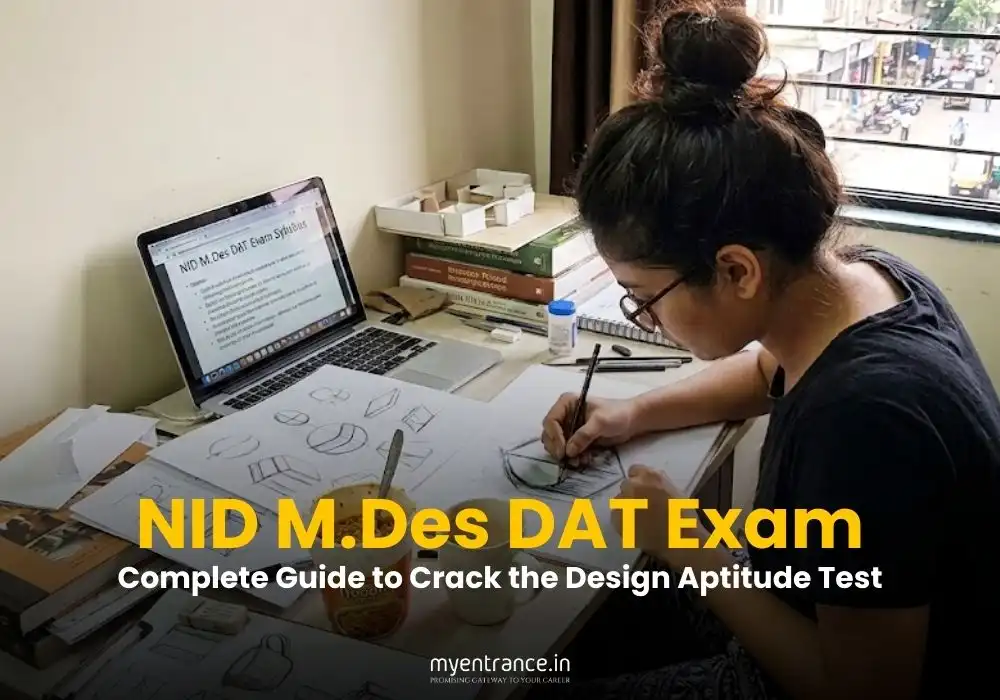
If you are passionate about design and dream of studying at one of India’s most prestigious design institutions, the NID M.Des DAT (Design Aptitude Test) is your gateway. Whether you are a fresh graduate or a working professional looking to elevate your design career, this exam is the first and most crucial step toward securing a seat at the National Institute of Design. In this comprehensive guide by myentrance.in, we break down everything you need to know about the NID MDES DAT exam, from its structure to preparation tips, important topics, and practice questions.
What is the NID MDES DAT Exam?
The NID M.Des DAT (Master of Design Design Aptitude Test) is a national-level entrance examination conducted by the National Institute of Design (NID), Ahmedabad. It serves as the qualifying test for admission to the two-year Master of Design (M.Des) programme offered across NID campuses in Ahmedabad, Bangalore, Jorhat, Kurukshoite, Andhra Pradesh, and Jordan.
The exam evaluates a candidate’s aptitude in design thinking, creativity, visual perception, and problem-solving abilities. NID offers specialisations in disciplines such as Graphic Design, Industrial Design, Textile Design, Digital Game Design, Photography Design, Animation Film Design, Film and Video Communication, and many more. The DAT exam is conducted in two stages: DAT Prelims (written test) and DAT Mains (studio test).
Exam Pattern and Structure
DAT Prelims is a written, objective, and descriptive test of approximately 3 hours. It includes sections on creative and lateral thinking, general knowledge of design, drawing and sketching, language and communication skills, and visual aptitude. DAT Mains is a studio-based test that includes hands-on creative tasks, portfolio review, and a personal interview. Only candidates who qualify the Prelims are called for Mains.
How to Prepare for the NID MDES DAT Exam
Preparation for the NID MDES DAT requires a mix of creative practice and academic study. Here are the most effective strategies:
- Start with a thorough understanding of the exam syllabus and previous year papers. Solve at least 5 years of past question papers to understand the pattern, frequently asked questions, and the level of difficulty.
- Practice sketching and drawing daily. Even 30 minutes of free-hand drawing, observational sketching, or design ideation sketches will significantly sharpen your visual communication skills.
- Develop design awareness by reading books such as ‘The Design of Everyday Things’ by Don Norman and ‘Thinking with Type’ by Ellen Lupton. Follow design magazines, attend exhibitions, and explore museums.
- Work on your general knowledge about design history, famous designers, design movements, material science, ergonomics, and current trends in design and technology.
- Build a strong portfolio. For Mains, your portfolio should reflect your best work, personal design projects, sketches, and any experimentation with materials or media.
- Join a NID coaching institute or online preparation community. Peer feedback and guided mock tests can dramatically improve your performance.
Topics to Be Referred
The NID MDES DAT syllabus covers a wide range of topics. Here is what you must be familiar with:
- Visual Aptitude and Perception: Spatial reasoning, pattern recognition, image-based problem solving.
- Drawing and Sketching: Perspective drawing, object rendering, human figure sketching, product sketching.
- Design Knowledge: Principles of design, elements of design, colour theory, typography, layout design.
- Design History: Bauhaus movement, Art Deco, Modernism, Indian design heritage, famous international designers.
- Creative Thinking and Lateral Reasoning: Brain teasers, creative problem solving, unconventional thinking exercises.
- Material Science and Ergonomics: Properties of materials, human factors in design, anthropometric data.
- Technology and Innovation: Emerging trends in UX/UI design, sustainable design, smart product design, packaging.
- General Knowledge and Current Affairs: National and international events related to arts, architecture, culture, science, and technology.
Most Important Topics to Cover
While all topics matter, candidates who ace the NID MDES DAT consistently emphasise the following as high-weightage areas:
- Colour Theory: Hue, saturation, value, colour harmony, warm and cool colours, and their psychological effects.
- Visual Puzzles and Pattern Completion: Frequently tested in the objective section to assess design aptitude.
- Product Design and Everyday Object Analysis: Questions about form, function, and usability of common products.
- Design Thinking Process: Empathise, Define, Ideate, Prototype, and Test — the five stages of design thinking.
- Indian Design and Craft Heritage: Traditional crafts, Indian textiles, regional art forms, and their contemporary relevance.
10 Sample Questions and Answers for NID MDES DAT
Here are 10 practice questions with answers to help you gauge your readiness:
Q1. Which colour is formed by mixing equal parts of red and yellow?
Answer: Orange. Red and yellow are primary colours, and their equal mix results in orange, a secondary colour.
Q2. What is the Bauhaus movement and why is it significant in design history?
Answer: Bauhaus was a German design school founded by Walter Gropius in 1919. It is significant because it unified fine arts and functional design, influencing modern architecture, industrial design, and typography with the principle that ‘form follows function.’
Q3. Identify the principle of design that refers to the size relationship between different elements.
Answer: Proportion or Scale. It describes how the size of one element relates to another within a composition, creating visual hierarchy.
Q4. What does ergonomics mean in product design?
Answer: Ergonomics refers to designing products or spaces for human comfort, efficiency, and safety by considering the physical and cognitive abilities of the user. Examples include the shape of a chair, keyboard layout, or grip design of a tool.
Q5. Name the five stages of the Design Thinking process.
Answer: The five stages are Empathise, Define, Ideate, Prototype, and Test. This human-centred approach to problem solving is widely used in UX design, product design, and innovation.
Q6. What is the golden ratio and how is it used in design?
Answer: The golden ratio (approximately 1:1.618) is a mathematical proportion found in nature and used in design to create aesthetically pleasing compositions. It guides layout, typography sizing, logo design, and spatial arrangements.
Q7. What is the difference between a logo, a logotype, and a brand mark?
Answer: A logo is the overall brand symbol. A logotype (or wordmark) is the brand name styled in a specific typeface (like Google or Coca-Cola). A brand mark is a graphic or icon representing the brand without text (like Apple’s apple or Nike’s swoosh).
Q8. Which traditional Indian craft involves dyeing cloth using wax as a resist technique?
Answer: Batik. This resist-dyeing technique, which uses wax to prevent dye penetration, is practised in parts of India, especially in Gujarat and West Bengal, and is also popular in Southeast Asia.
Q9. What is negative space in design?
Answer: Negative space (also called white space) is the empty area surrounding the main subject or elements in a design. It helps improve readability, create visual balance, and sometimes forms hidden imagery, like the arrow in the FedEx logo.
Q10. Name the Indian designer known for pioneering contemporary Indian design and co-founding India’s first design school (NID).
Answer: Charles Correa is credited in Indian architecture, but for NID’s founding, it was the work led by Charles and Ray Eames (American designers) who submitted the India Report in 1958, which led to the establishment of NID in 1961 in Ahmedabad.
Top Preparation Tips from myentrance.in Experts
- Practise sketching from imagination, not just reference — the DAT Mains tests your ability to visualise and execute ideas quickly.
- Solve at least 2 to 3 visual reasoning or puzzle exercises daily to strengthen your spatial intelligence.
- Read newspapers and design publications to stay updated on current events that relate to architecture, art, technology, and environmental design.
- Time management during the exam is critical. Allocate specific minutes per section and avoid spending too long on a single question.
- For the Studio Test in Mains, always present your ideation process — rough sketches, thinking steps, and rationale — and not just the final solution.





