
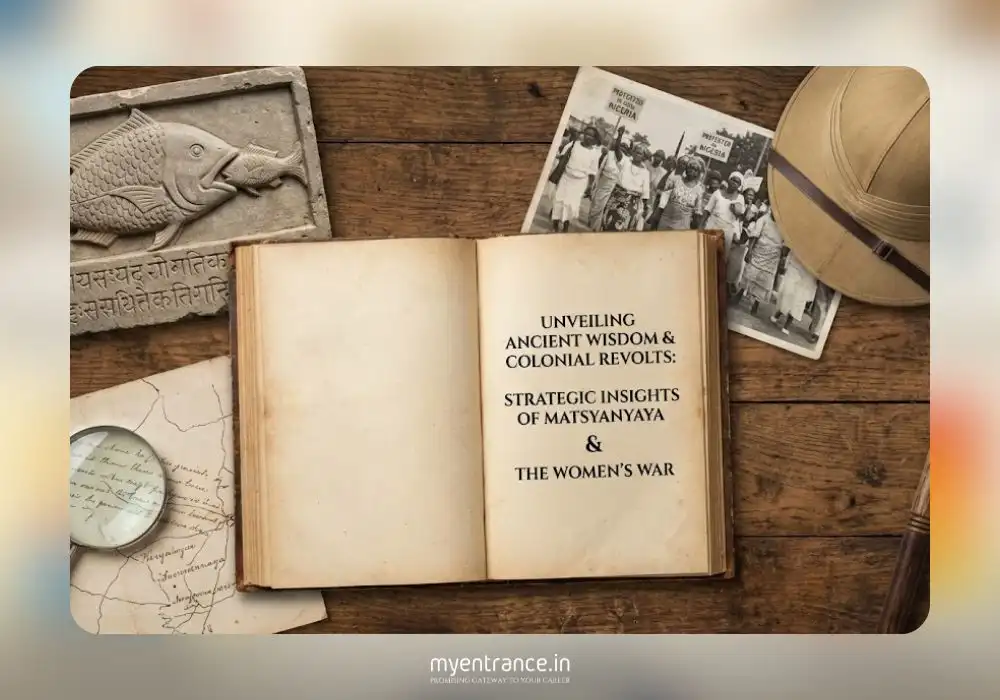
For aspirants preparing for competitive examinations such as UPSC, SSC, and PSC, a profound understanding of historical and cultural phenomena is not merely about memorizing facts but about grasping their core essence, implications, and connections. This guide delves into two distinct yet equally significant concepts often encountered in various competitive exam syllabi: the ancient Indian political philosophy of *Matsyanyaya*, often translated as the ‘Law of the Fish’, and the powerful anti-colonial resistance movement known as the Aba Women’s War, sometimes referred to as the ‘Women’s War’. By exploring their origins, significance, and lasting impact, we aim to provide a comprehensive and analytical perspective crucial for your preparation.
Matsyanyaya: The Ancient Indian Philosophy of State and Order
What is Matsyanyaya?
*Matsyanyaya*, literally meaning the ‘Law of the Fish’, is a foundational concept in ancient Indian political thought. It vividly describes a state of anarchy or chaos where, in the absence of a strong governing authority, the powerful exploit and oppress the weak, much like larger fish devour smaller ones in a water body. This metaphor underscores the inherent human tendency towards self-interest and aggression if unchecked by an external, coercive force. It paints a picture of societal breakdown, where justice is non-existent, and might becomes the sole determinant of right.
Why is Matsyanyaya Significant?
The profound significance of *Matsyanyaya* lies in its justification for the necessity of a sovereign state and a strong ruler. Ancient Indian thinkers used this concept to argue that the existence of a king or a governing body, empowered to enforce laws and mete out punishment (*danda*), is indispensable for maintaining social order, protecting individual rights, and ensuring the prevalence of *dharma* (righteous conduct and moral law). Without this state power, society would descend into lawlessness, rendering life insecure and progress impossible. It serves as a powerful reminder of the delicate balance between individual freedom and the need for collective governance.
Where and When was Matsyanyaya Discussed?
This crucial concept appears in a wide array of ancient Indian texts, reflecting its pervasive influence on political philosophy. It is most prominently elaborated in Kautilya’s *Arthashastra*, a seminal treatise on statecraft, economics, and military strategy, believed to have been composed around the 3rd or 4th century BCE. Kautilya uses *Matsyanyaya* to articulate the rationale behind a strong monarchical state. Beyond the *Arthashastra*, the concept also finds mention in the *Mahabharata*, particularly in the *Shantiparva* section, which discusses duties of kings and governance. Other texts, including the *Manusmriti* and various Puranas, also allude to the idea, reinforcing the consistent recognition of this principle throughout ancient Indian intellectual history, primarily from the post-Vedic period onwards.
How does Matsyanyaya Shape Governance?
The concept of *Matsyanyaya* directly influences the ancient Indian understanding of governance. It posits that a ruler’s primary duty is to prevent this ‘Law of the Fish’ from prevailing. This is achieved through the judicious application of *danda* (punishment or coercion), which is seen not merely as a punitive measure but as a righteous instrument to uphold *dharma* and ensure justice. A king who fails to administer *danda* effectively is deemed to be allowing *Matsyanyaya* to flourish, thereby failing in his duties. Thus, it advocates for a robust legal system, a strong administrative apparatus, and a vigilant sovereign to protect the weak from the strong, fostering an environment where individuals can pursue their livelihoods and spiritual goals without fear.
The Aba Women’s War: A Landmark of Anti-Colonial Resistance
What was the Aba Women’s War?
The Aba Women’s War, also widely known as the Aba Women’s Riots of 1929, was a powerful and organized protest by women in southeastern Nigeria against the British colonial administration. While termed a ‘war’ or ‘riots’, it was primarily a series of meticulously planned and executed demonstrations and acts of civil disobedience. Women from various ethnic groups, including Igbo, Ibibio, and Opobo, united to challenge colonial policies that they perceived as unjust and detrimental to their livelihoods and traditional societal roles.
Why did the ‘Women’s War’ Erupt?
Several deep-seated grievances culminated in the Aba Women’s War. The primary catalyst was the colonial government’s attempt to impose direct taxation on women, a policy that violated traditional customs and placed an undue economic burden on them. Furthermore, the British-introduced Warrant Chief system replaced traditional community leaders with individuals often lacking legitimate authority, leading to corruption, abuse of power, and erosion of local governance structures. Women also protested against exploitative trading practices by European companies, declining palm oil prices, and the general undermining of their economic independence and political influence within their communities, which had historically been significant.
Where and When did this Uprising Occurred?
The protests primarily unfolded in the Owerri and Calabar provinces of southeastern Nigeria, specifically in areas around Aba, Opobo, and other communities inhabited by Igbo, Ibibio, and Opobo peoples. While the grievances had been simmering for a while, the active phase of the ‘Women’s War’ occurred between November and December 1929. The movement spread rapidly across a vast geographical area, demonstrating the widespread discontent and the women’s ability to mobilize effectively across ethnic lines.
How was the Aba Women’s War Conducted and What were its Consequences?
The women employed various traditional methods of protest, collectively known as “sitting on a man” or “making war on a man,” which involved large groups of women congregating, singing critical songs, dancing, and shaming the perceived wrongdoers or colonial agents. They targeted warrant chiefs, native courts, and European-owned shops and properties, often destroying symbols of colonial authority and economic exploitation. Despite the peaceful intent of many protests, colonial forces responded with violence, leading to numerous casualties among the women.
The Aba Women’s War had significant and lasting consequences. It forced the British colonial government to abandon its plans to tax women and to institute reforms in the Warrant Chief system. The protests exposed the deep flaws in the colonial administration’s understanding of local customs and governance. More importantly, it highlighted the immense power of women’s collective action and their crucial role in anti-colonial resistance, challenging patriarchal assumptions within both colonial and some traditional structures. The ‘Women’s War’ is remembered as a pivotal moment in Nigerian history and a testament to the resilience and agency of African women.
Frequently Asked Questions and Answers
1. What is the core principle of Matsyanyaya and which ancient Indian text prominently discusses it?
The core principle of Matsyanyaya is the ‘Law of the Fish’, which describes a state of anarchy where the strong oppress the weak in the absence of a strong ruler. Kautilya’s *Arthashastra* is the ancient Indian text that most prominently and comprehensively discusses this concept, using it to justify the necessity of a sovereign state for maintaining social order and justice.
2. How does the concept of ‘Danda’ relate to Matsyanyaya in ancient Indian political thought?
In ancient Indian political thought, *Danda* (punishment or coercion) is directly related to *Matsyanyaya* as the essential tool for preventing it. A strong ruler, through the judicious and righteous application of *Danda*, ensures that the ‘Law of the Fish’ does not prevail. It compels individuals to adhere to *dharma* and maintains order, protecting the weak from exploitation by the powerful.
3. What were the primary causes of the Aba Women’s War of 1929?
The primary causes of the Aba Women’s War included the proposed direct taxation of women by the British colonial government, which was a cultural affront and economic burden. Other significant factors were the oppressive and corrupt Warrant Chief system, the decline in palm oil prices affecting women’s livelihoods, and the general erosion of women’s traditional economic and political influence under colonial rule.
4. Where did the Aba Women’s War primarily take place, and what was its immediate impact on colonial administration?
The Aba Women’s War primarily took place in the Owerri and Calabar provinces of southeastern Nigeria, specifically in and around communities like Aba and Opobo. Its immediate impact on colonial administration was significant; it forced the British to halt their plans to tax women, led to reforms in the much-criticized Warrant Chief system, and prompted a re-evaluation of British colonial policies in the region.
5. How did the Aba Women’s War challenge the traditional perceptions of women’s roles in anti-colonial resistance?
The Aba Women’s War profoundly challenged traditional perceptions by demonstrating that women were not merely passive observers but active and formidable agents of anti-colonial resistance. It showcased their capacity for organized political action, mass mobilization, and direct confrontation with colonial authority, proving their vital role in shaping historical outcomes and influencing policy changes.





