
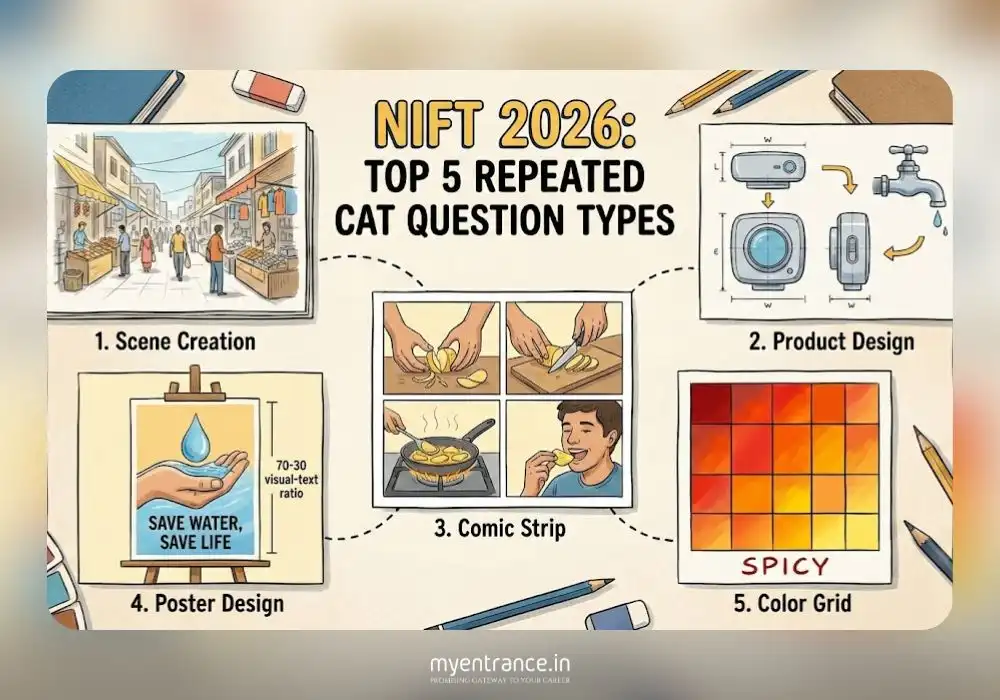
Dreaming of a career in fashion or design? To get into NIFT (National Institute of Fashion Technology), you have to crack the Creative Ability Test (CAT). This isn’t just about drawing pretty pictures; it’s about solving problems through drawing. Based on expert trends, here are the Top 5 Question Types that show up almost every year. Master these, and you are halfway there!
1. Scene Creation (The “Imagine It” Question)
What is it? The exam will give you a situation—like “A busy market,” “A messy bedroom,” or “A view from a window”—and ask you to draw it.
Pro Tips:
Put a Human in It: A scene looks empty without people. Even if the question says “Draw what you see,” draw your own hands holding a cup or your feet resting on the floor.
Create Depth (Perspective): Things close to you should look big, and things far away should look small. Practice “1-point perspective” (where everything vanishes into one dot in the distance).
Read Carefully: If they ask for a “Waiting Room,” don’t just draw chairs; draw the clock, the magazines, and the bored people!
2. Product Design (The “Fix It” Question)
What is it? You might be asked to redesign an everyday object or solve a problem.
Example: “Design a gadget to stop a tap from leaking until the plumber arrives.”
Pro Tips:
Show How It Works: Don’t just draw one picture. Draw the Front View, Side View, and Top View so the examiner understands your idea.
Textures Matter: If your product is made of plastic, it should look smooth. If it’s wood, draw wood grain lines.
Be Creative: Don’t draw a boring solution. Think of something unique (like using a rubber tube or a bottle cap).
3. Comic Strips (The “Story” Question)
What is it? You have to draw a process step-by-step in 3 or 4 boxes (frames).
Example: “Draw the process of making potato chips” or “Changing a lightbulb.”
Pro Tips:
Start to Finish:
Box 1: Start the story (Peeling potatoes).
Box 2 & 3: The action (Slicing and frying).
Box 4: The result (Eating the chips).
Zoom In & Out: Don’t draw the same view every time.
Frame 1: Show the whole kitchen (Wide shot).
Frame 2: Zoom in on the hands cutting the potato (Close up).
Logical Flow: Make sure the story makes sense without needing too many words.
4. Poster Design (The “Message” Question)
What is it? You will need to make a poster for a social cause (like “Save Water”) or a brand advertisement.
Pro Tips:
Less Text, More Art: Keep the slogan short and catchy. The drawing should cover 70-80% of the paper.
Match the Mood: If the topic is serious (like pollution), use bold, strong fonts. If it’s fun (like a festival), use bubbly, happy fonts.
Smart Coloring: Running out of time? You don’t have to color the whole background. You can color just the main object or half of it to make it look artistic and save time.
5. Color Grid (The “Emotion” Question)
What is it? They will give you a grid (boxes) or shapes and ask you to fill them with colors that represent a specific feeling or theme.
Example: “Color this grid to show ‘Night’ or ‘Spicy Food’.”
Pro Tips:
Pick the Right Colors:
Night: Dark Blue, Purple, Black, maybe a little yellow for stars.
Spicy Food: Red, Orange, Bright Yellow.
Anxiety: Grey, black, chaotic scribbles.
Be Neat: This test is about how clean your work is. Don’t let colors spill outside the lines!
What Should You Practice Right Now?
If you want to ace NIFT 2026, start practicing these three basics today:
Perspective: Learn to draw rooms and streets that look 3D.
Human Figures: Practice drawing hands, feet, and faces (they don’t need to be perfect, just correct proportions).
Speed: Try to finish your drawings within a time limit.
Good luck! You’ve got this!





