
Imagine sitting in the examination hall for NID DAT or UCEED. You face a complex General Knowledge question or a tricky design aptitude challenge. You need an innovative solution, fast. Where do you look for inspiration?
The smartest designers don’t just look forward at technology; they look backward at nature.
This concept is called Biomimicry, and it is an absolute favorite topic for examiners setting papers for NID, UCEED, CEED, and NIFT. Mastering this topic can give you a significant edge in both objective GK sections and subjective design challenges.
Here is your essential guide to understanding Biomimicry and how to use it to ace your design exams.
What is Biomimicry?
Put simply, Biomimicry is nature-inspired design.
It involves studying nature’s best ideas—time-tested patterns and strategies that have evolved over millennia—and emulating them to solve human challenges.
Nature has already solved many of the problems we face today: energy efficiency, durability, aerodynamics, and sustainability. Biomimicry isn’t just about making things look like nature; it’s about understanding how nature works and applying those principles to human inventions.
The Biomimicry Hall of Fame (Memorize These!)
For the GK sections of UCEED and NID, you need to know the classic examples of biomimicry. These are frequently asked questions and represent foundational design knowledge.
Here are four essential examples you must know before walking into the exam hall:
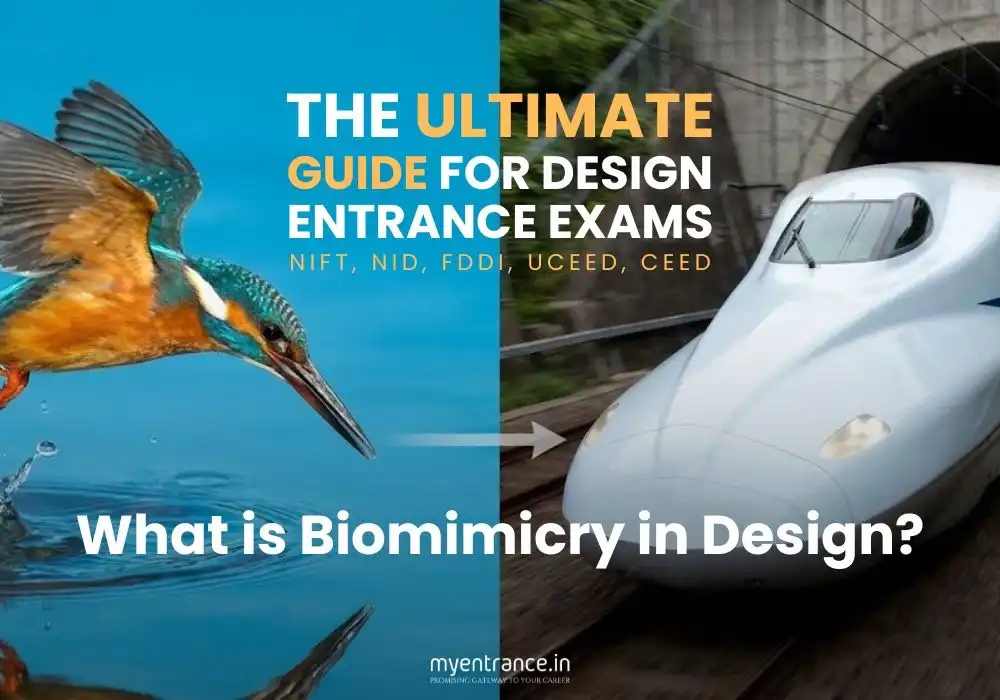
1. The Shinkansen Bullet Train & The Kingfisher
The Problem: Japan’s high-speed trains were creating incredibly loud “sonic booms” when exiting tunnels due to air pressure buildup.
Nature’s Solution: The Kingfisher bird. It can dive from the air into the water without making a splash to catch fish.
The Design: Engineers redesigned the train’s nose to mimic the Kingfisher’s sleek, pointed beak.
The Result: The new design sliced through the air, significantly reducing noise, lowering electricity usage, and allowing the train to travel 10% faster.
2. Velcro & Cockleburrs
The Inspiration: In 1941, Swiss engineer George de Mestral took his dog for a walk and noticed cockleburrs (seeds covered in tiny hooks) stuck tightly to his dog’s fur and his trousers.
The Design: He examined the burrs under a microscope and replicated the hook-and-loop mechanism using synthetic materials.
The Result: Velcro—one of the most ubiquitous fastening systems on the planet.
3. Eastgate Centre (Zimbabwe) & Termite Mounds
The Problem: How to keep a large office building cool in a hot climate without expensive, energy-guzzling air conditioning.
Nature’s Solution: Termite mounds. Despite searing outside temperatures, the inside of a termite mound stays at a constant, cool temperature due to a complex system of air vents and tunnels that circulate air passively.
The Design: The building was designed with a similar passive ventilation system, using natural airflow to regulate temperature.
The Result: A building that uses 90% less energy for cooling than conventional buildings of its size.
4. Sharklet & Shark Skin
The Problem: Bacteria buildup on hospital surfaces and medical devices.
Nature’s Solution: Sharks. Unlike whales, sharks don’t get barnacles or algae growing on them. Their skin is covered in tiny, tooth-like scales called denticles that create a rough surface bacteria cannot adhere to.
The Design: Sharklet is a synthetic surface material that mimics this microscopic pattern.
The Result: A surface that physically repels bacteria without using chemicals or antibiotics.
How to Apply Biomimicry in Your Exam (The Game Changer)
Knowing the examples is great for GK. But applying them in the subjective (drawing/design) sections of exams like NIFT CAT or CEED is where you score big marks.
Examiners love seeing students who look beyond the obvious solutions.
The Exam Scenario: You get a question like: “Create a sustainable packaging solution for fruit.”
The Average Student Answer: Draws a cardboard box with holes in it and labels it “Recyclable.” (This is fine, but predictable).
The “Biomimicry” Student Answer: Instead of just looking at materials, look at nature’s strategies.
Your Proposal: Design a “Self-Cleaning Packaging” surface.
The Inspiration: The Lotus Leaf Effect. Lotus leaves grow in muddy water but always remain clean because their micro-structures make water bead up and roll off, taking dirt with it (superhydrophobicity).
The Application: You propose packaging with a similar microscopic surface texture that repels water and dirt, keeping the fruit clean without needing chemical washes or detergents.
Why it Wins: This answer shows deep thinking, innovation, and a true understanding of sustainability beyond just “using cardboard.”
Final Tip for Aspirants: when you are preparing for your design exams, don’t just study man-made objects. Take time to observe nature. Ask yourself, “How does nature solve this problem?” That question might just be the key to your dream design college.





