
India’s Quantum Leap: The Indigenous Quantum Diamond Microscope and a New Dawn for Scientific Sovereignty
India has once again inscribed its name on the global scientific map, not merely as a participant but as a pioneering force. The nation has taken a monumental leap into the vanguard of advanced technology with the unveiling of its first fully indigenous Quantum Diamond Microscope (QDM). This is more than just a new instrument; it is a testament to a resurgent scientific spirit, a symbol of self-reliant innovation, and a key that will unlock mysteries at the frontier of human knowledge. Forged in the crucible of Indian intellect by the brilliant P-Quest Group at IIT Bombay, this cutting-edge tool was grandly revealed at the prestigious Emerging Science Technology and Innovation Conclave (ESTIC 2025). This event marks not just the launch of a device, but the dawn of a new era of scientific exploration, positioning India firmly at the forefront of the global quantum technology race.
Demystifying the Marvel: The Science Behind the Quantum Diamond Microscope
To comprehend the magnitude of this achievement, one must first understand what sets the Quantum Diamond Microscope apart from any microscope one might encounter in a standard laboratory. Traditional microscopes, even powerful electron microscopes, rely on illuminating a sample with light or electrons and capturing the interaction to form an image. The QDM, however, operates on an entirely different principle—it is a quantum sensor that visualizes magnetic fields with atomic-scale precision.
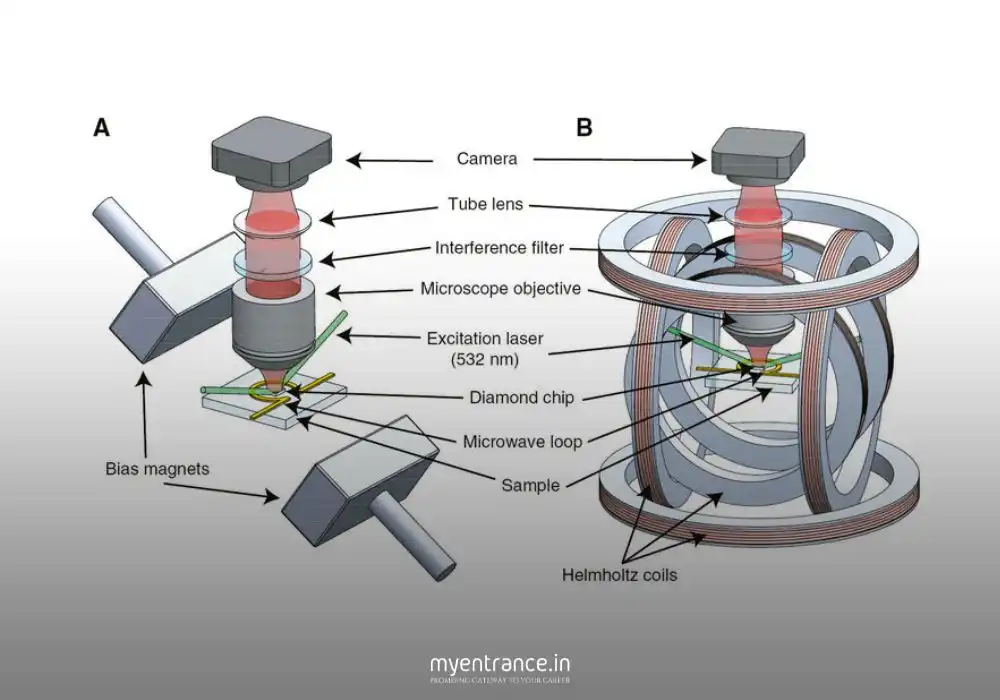
At the very heart of this revolutionary device lies a seemingly mundane object: a diamond. But this is no ordinary gemstone. Within its crystalline lattice, scientists engineer minute, atomic-scale flaws known as Nitrogen-Vacancy (NV) centers. Imagine a perfectly stacked grid of carbon atoms where one carbon is missing (a vacancy), and an adjacent spot is occupied by a nitrogen atom. This NV center is the engine of the QDM. These centers possess a unique quantum property: their electronic spin state is exquisitely sensitive to magnetic fields. When a green laser is shined upon the diamond, the NV centers fluoresce, emitting red light. The intensity of this red light directly corresponds to the spin state of the NV center, which in turn is influenced by the faintest magnetic fields from the sample placed near the diamond.
In practice, the QDM uses a diamond chip embedded with a layer of these NV centers. A sample—be it a neuron firing, a novel 2D material, or a semiconductor chip—is placed on this chip. As the QDM’s laser scans the sample, it doesn’t directly image the physical structure; instead, it maps the minuscule magnetic fields emanating from it. This allows researchers to “see” phenomena that are otherwise invisible. The most profound advantage is its non-invasive nature. Unlike techniques that require freezing, staining, or physically altering samples—often destroying them in the process—the QDM can observe dynamic processes in their natural, ambient environment. It is, in essence, giving scientists a pair of glasses to see the hidden magnetic soul of the microscopic world.
A Catalyst for Discovery: The Multisectoral Revolution
The development of an indigenous QDM is not an academic exercise; it is a strategic tool poised to accelerate breakthroughs across a multitude of critical domains, transforming research from a observational science to a precise, quantitative one.
-
Neuroscience Reimagined: The human brain is an electrochemical organ, and every neural impulse generates a tiny magnetic field. The QDM’s unparalleled sensitivity allows neuroscientists to map these fields with millisecond precision and micron-scale resolution. Researchers can now observe the intricate firing patterns of neural networks in real-time, potentially unlocking the mechanisms behind neurodegenerative diseases like Alzheimer’s and Parkinson’s, deciphering the neural code of memory, and developing more effective neurotherapeutics. It offers a pathway to understanding the brain’s connectome—the complete wiring diagram—with unprecedented clarity.
-
Materials Science at the Atomic Frontier: The quest for newer, stronger, and more functional materials is relentless. The QDM empowers scientists to probe the fundamental magnetic and electronic properties of materials like graphene, high-temperature superconductors, and complex oxides at the nanoscale. By visualizing how magnetic domains interact, how defects form, and how strain affects material properties, engineers can design materials from the atom up. This could lead to more efficient catalysts for clean energy, lighter and stronger alloys for aerospace, and novel materials for quantum computing.
-
Securing the Digital Future: Semiconductor Diagnostics: In an era defined by electronics, the semiconductor industry is the bedrock of modern civilization. As chips shrink to atomic dimensions, detecting and diagnosing faults becomes exponentially harder. The QDM can perform non-destructive failure analysis on live chips, pinpointing defects, mapping current flow, and identifying “hot spots” that lead to failure. This capability is crucial for developing next-generation, reliable, and powerful semiconductors, bolstering India’s ambitions in electronics manufacturing and design, and reducing dependency on foreign diagnostic technology.
-
Broader Horizons: The applications extend even further. In medicine, it could track magnetic nanoparticles attached to drug molecules, visualizing their journey through the body. In geology, it could analyze the magnetic signatures in rock samples to understand planetary formation. In fundamental physics, it can be used to search for exotic particles like axions, which are candidates for dark matter. The QDM is not a single-purpose tool but a versatile platform for discovery.
The Strategic Imperative: Why Indigenous Development Matters
The creation of the QDM at IIT Bombay is a landmark event that transcends the laboratory walls. It is a powerful statement of India’s growing scientific sovereignty. High-end scientific instrumentation has traditionally been a market dominated by a handful of Western and Japanese companies. Acquiring such equipment is not only expensive, involving significant foreign currency outflow, but also comes with constraints—limited customization, restrictive service agreements, and potential export controls on the most advanced models.
By developing the QDM indigenously, India has achieved several strategic objectives:
-
Technological Self-Reliance (Atmanirbharta): It reduces critical dependency on foreign imports, ensuring that Indian scientists have uninterrupted access to cutting-edge tools, a vital component for a thriving research ecosystem.
-
Cost-Effectiveness and Customization: Indigenous development dramatically lowers costs, making the technology accessible to a wider pool of universities and research institutes. Furthermore, Indian scientists can now customize the QDM to address specific national challenges, be it in healthcare, agriculture, or defense.
-
A Foothold in the Quantum Race: Quantum technology is widely seen as the next technological revolution, with nations investing billions. The QDM is a tangible, world-class product that demonstrates India’s capability to not just follow, but to lead and innovate in this demanding field. It builds a foundational ecosystem of expertise in quantum sensing, a critical pillar of quantum technology.
-
Inspiration for the Next Generation: This achievement serves as a beacon, inspiring countless young students to pursue careers in science, technology, engineering, and mathematics (STEM). It proves that world-class innovation is not the sole purview of other nations but can be, and is being, driven from within India.
A Crucial Beacon for Aspirants and the Nation
For students diligently preparing for the nation’s premier competitive examinations—be it the UPSC, SSC, PSC, NID, or NIFT—this breakthrough is far more than a current affairs headline. It is a case study in national progress. It embodies the dynamic interplay between fundamental research, technological application, and strategic policymaking. Understanding such developments is crucial for the General Awareness and Essay papers, as they reflect the direction of India’s developmental trajectory. This story is about the power of investing in education (IITs), fostering research and development (P-Quest Group), and the national ambition to be a “Vishwaguru” not just in culture, but in science and technology. It underscores a pivotal message: the future belongs to those who can imagine, innovate, and build, and with the Quantum Diamond Microscope, India has proven it is ready to do just that.
Frequently Asked Questions (FAQs)
1. What exactly is a Quantum Diamond Microscope (QDM)? A QDM is a highly advanced quantum sensing instrument that uses atomic-scale defects in diamond crystals, called Nitrogen-Vacancy (NV) centers, to detect and image minuscule magnetic fields. It functions not by magnifying light, but by mapping the magnetic “signature” of a sample, allowing for non-invasive, high-precision observation at the nanoscale.
2. Who developed India’s first indigenous QDM? The pioneering development was carried out by the P-Quest research group at the Indian Institute of Technology Bombay (IIT Bombay), showcasing the institute’s leadership in cutting-edge scientific research.
3. When and where was this achievement announced? The indigenous Quantum Diamond Microscope was formally unveiled to the public at the ESTIC 2025 (Emerging Science Technology and Innovation Conclave), a high-profile platform dedicated to showcasing India’s advancements in science and technology.
4. What are the primary fields that will benefit from this QDM? The QDM is set to revolutionize several fields, including:
-
Neuroscience: For real-time mapping of brain activity.
-
Materials Science: For designing and testing new materials at the atomic level.
-
Semiconductor Diagnostics: For non-destructive failure analysis and improving chip performance.
-
Other areas include quantum computing research, drug discovery, and geology.
5. Why is the indigenous development of a QDM so significant for India? It signifies India’s growing self-reliance in high-technology, reduces critical dependency on foreign imports, fosters a domestic ecosystem for quantum technology, and establishes the country as a serious innovator and global leader in a strategically vital field of the 21st century.





