
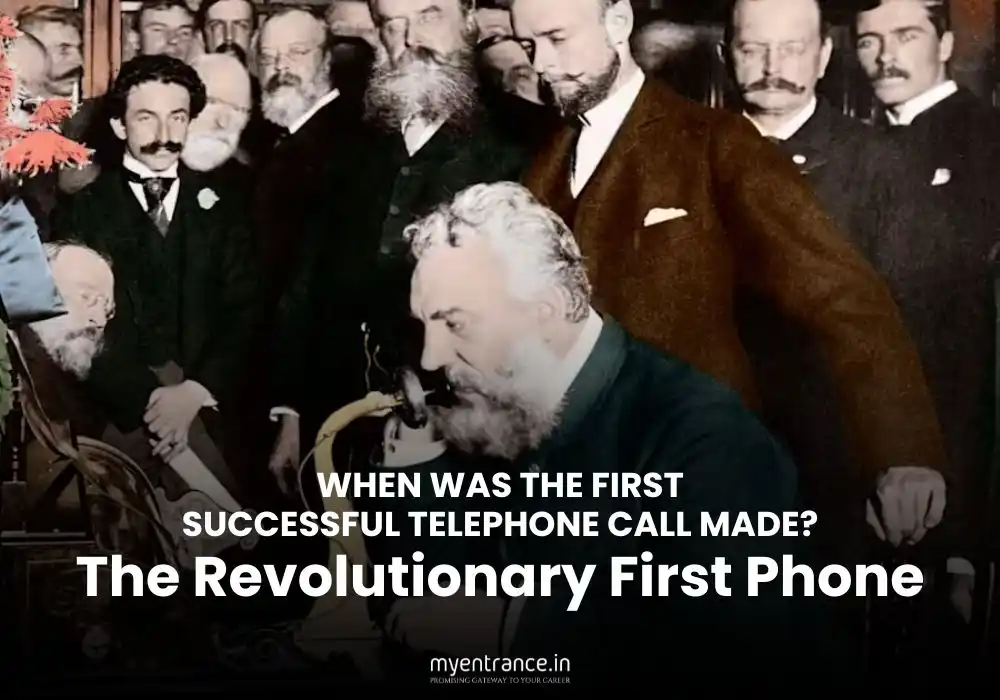
The Human Quest for Connection: Why the Telephone Mattered
Since time immemorial, humanity has yearned to bridge distances with voice. The clatter of a telegraph, while revolutionary, lacked the personal touch, the nuances of human speech. Imagine a world where news traveled only as fast as a horse or a ship, where conversations across continents were a distant dream. This profound need for instant, direct vocal communication laid the groundwork for one of history’s most transformative inventions: the telephone. Its genesis marked a pivotal moment, fundamentally altering how societies interact, conduct business, and even wage war, setting the stage for every communication marvel we enjoy today. For students preparing for SSC, UPSC, PSC, NID, NIFT, and other government exams, understanding the birth of the telephone is not just about memorizing a date; it’s about grasping the core of technological innovation and its societal impact, a crucial element of static general knowledge and historical context.
Alexander Graham Bell: The Visionary Behind the Voice
The story of the telephone is inextricably linked with the name Alexander Graham Bell. Born in Edinburgh, Scotland, Bell’s family had a deep connection to sound and communication; his grandfather was an elocution teacher, and his father invented “Visible Speech,” a system used to teach the deaf. This lineage, coupled with his own profound interest in acoustics and his work with the deaf, cultivated a unique perspective that would eventually lead to the invention of the telephone. While other brilliant minds, such as Elisha Gray and Antonio Meucci, were independently exploring similar concepts, it was Bell’s relentless experimentation and successful patenting that cemented his place as the widely recognized inventor of the practical telephone. His journey was one of persistent curiosity, driven by a desire to improve communication and, specifically, to make sound visible for the hearing impaired.
The Genesis of Sound Transmission: When and Where It Happened
The exact moment the world began to shrink with sound occurred on a momentous day: March 10, 1876. In a small laboratory in Boston, Massachusetts, Alexander Graham Bell, alongside his dedicated assistant Thomas A. Watson, made history. Bell, having spilled some acid on himself, famously uttered the words, “Mr. Watson, come here, I want to see you.” These weren’t just the first words spoken over a telephone; they were words that ignited a global revolution. This simple, yet monumental, transmission demonstrated that human speech could indeed be converted into electrical signals, sent across a wire, and reconstituted as sound at the other end. This wasn’t merely a theoretical breakthrough; it was a practical demonstration that proved the viability of instantaneous, personal voice communication over distance, forever changing the trajectory of human interaction.
How It Worked: A Glimpse into Early Telephony
At its core, the early telephone was an ingenious device designed to convert sound energy into electrical energy and then back again. When Bell spoke into his prototype transmitter, his voice created vibrations in a diaphragm. This diaphragm was connected to an armature, which moved within a magnetic field, generating varying electrical currents. These electrical currents, essentially a blueprint of his voice, traveled through a wire to the receiver. At the receiver end, the process was reversed: the fluctuating electrical currents would pass through an electromagnet, causing another diaphragm to vibrate. These vibrations replicated the original sound waves, allowing Watson to hear Bell’s voice. Unlike the telegraph, which relied on coded electrical pulses to transmit information, the telephone was revolutionary because it transmitted the *actual voice*, preserving its tone, inflection, and identity, thereby fostering a much more natural and intuitive form of communication.
The Unstoppable March of Progress: Impact and Evolution
The invention of the telephone quickly transcended its initial laboratory triumph. Within years, Bell formed the Bell Telephone Company, and the device began its meteoric rise. Businesses found it indispensable for coordinating operations, families could connect across towns and eventually countries, and emergency services gained a vital tool. The telephone laid the groundwork for future innovations like radio, television, and ultimately, the internet, profoundly impacting every facet of modern life. It democratized communication, making it accessible to individuals and connecting communities in unprecedented ways. For exam aspirants, understanding this progression highlights the interconnectedness of scientific discovery and its profound socio-economic and political consequences, often featured in general awareness sections. The telephone’s journey from a scientific curiosity to a global necessity is a testament to human ingenuity and our endless pursuit of better ways to connect.
Frequently Asked Questions (FAQs)
1. Who is widely credited with inventing the first practical telephone?
Alexander Graham Bell is widely credited with inventing the first practical telephone, successfully demonstrating and patenting his device in 1876. While several inventors were exploring similar technologies, Bell’s system was the first to gain widespread public recognition and commercial success.
2. When was the first successful telephone call made?
The first successful telephone call was made on March 10, 1876, in Boston, Massachusetts. This is when Alexander Graham Bell uttered the famous words to his assistant, Thomas A. Watson.
3. What were the first words spoken over the telephone?
The first words successfully transmitted and received over a telephone were, “Mr. Watson, come here, I want to see you.” These words were spoken by Alexander Graham Bell to his assistant, Thomas A. Watson.
4. How did the early telephone fundamentally differ from the telegraph?
The fundamental difference lies in their method of transmission: the telegraph transmitted coded electrical pulses, often Morse code, which then had to be interpreted. In contrast, the telephone converted actual human speech into varying electrical signals, transmitting the speaker’s voice directly, allowing for instant, natural two-way vocal communication.
5. Why is understanding the invention of the telephone important for competitive exams?
Understanding the invention of the telephone is crucial for competitive exams as it falls under static general knowledge, history of science and technology, and current affairs (as a foundational technology). Questions about significant inventions, inventors, their impact on society, and the evolution of communication are common in sections like General Studies, GK quizzes, and comprehensive analytical questions in exams like UPSC, SSC, and PSC.





