
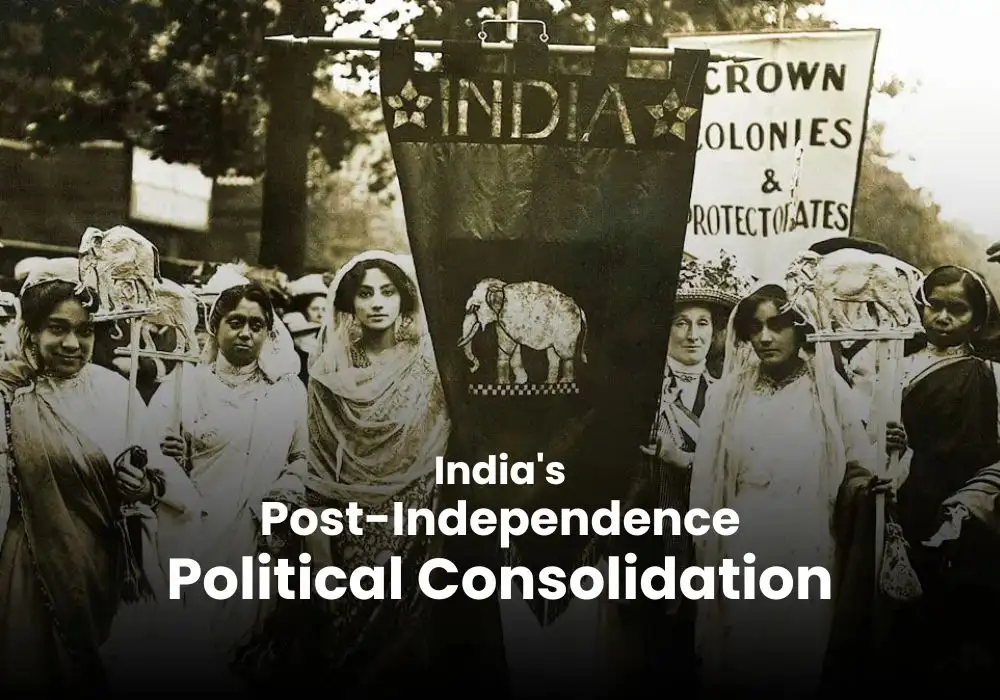
The birth of independent India in 1947 was not merely the end of colonial rule, but the beginning of an unprecedented and complex challenge: forging a unified nation from a fragmented political landscape. This monumental task of political consolidation and national unity, often overlooked in its intricacy, laid the foundational bedrock for the world’s largest democracy. Understanding this pivotal period is indispensable for any aspirant preparing for competitive examinations, as it illuminates the very essence of modern Indian statecraft.
The Dawn of Division: Inheriting a Fractured Legacy
When the British departed, they left behind not a singular nation, but a patchwork of provinces and over 560 princely states, each with varying degrees of autonomy, alongside the harrowing legacy of Partition. The immediate post-independence scenario was fraught with immense challenges: communal violence tearing through the fabric of society, widespread poverty, illiteracy, and the daunting prospect of integrating these disparate administrative units into a cohesive federal structure. The very idea of India as a unified political entity was an audacious dream, constantly under threat from internal fissiparous tendencies and external pressures.
The Architect of Unity: Sardar Patel’s Unparalleled Diplomacy and Resolve
At the heart of India’s initial political consolidation stood Sardar Vallabhbhai Patel, the first Deputy Prime Minister and Home Minister. His unwavering resolve, astute political acumen, and extraordinary negotiating skills were instrumental in integrating the vast majority of princely states into the Indian Union. Through a combination of persuasive diplomacy, strategic offers of privy purses and guarantees, and, when necessary, firm action (as seen in Junagadh, Hyderabad, and Kashmir), Patel orchestrated a bloodless revolution. The Instruments of Accession, signed by the rulers, effectively merged these historical entities into the newly independent nation, demonstrating an unparalleled feat of statesmanship that transformed a geographical expression into a political reality. This process, completed in a remarkably short span, prevented a Balkanization of the subcontinent and created a strong, centralized administrative structure.
The Guiding Star: India’s Constitution as a Blueprint for National Cohesion
Beyond the immediate integration of princely states, the long-term consolidation of India rested significantly on its meticulously crafted Constitution. Adopted in 1950, this monumental document established a robust federal system with a strong unitary bias, crucial for holding diverse regions together. It enshrined fundamental rights for all citizens, irrespective of caste, creed, or religion, fostering a sense of shared identity and belonging. The provision of single citizenship, a uniform judicial system, an independent Election Commission, and a parliamentary democracy ensured that while regional diversities were acknowledged, a powerful central authority could maintain stability and promote national interests. The Constitution thus provided the legal and philosophical framework for unity amidst unparalleled diversity, articulating a vision of a secular, democratic republic.
Reorganizing for Harmony: The Creation of Linguistic States
The challenge to national unity did not end with the integration of princely states. The demand for states based on linguistic identity emerged as a potent force, threatening to unravel the nascent nation. Initially hesitant, the Indian leadership, under Prime Minister Jawaharlal Nehru, ultimately recognized the need to accommodate these deeply felt cultural and linguistic aspirations. The States Reorganisation Act of 1956, based on the recommendations of the Fazal Ali Commission, redrew the internal map of India, creating states predominantly along linguistic lines. While this process was not without friction and resulted in some agitations, it ultimately proved to be a masterstroke in consolidating national unity. By providing a legitimate avenue for linguistic groups to express their identity within the Indian framework, it defused separatist tendencies and strengthened the bond between citizens and their regional homelands, thereby enhancing their allegiance to the larger Indian nation.
Sustaining the Vision: Democratic Institutions and Inclusive Governance
The enduring success of India’s political consolidation lies in its commitment to democratic institutions and inclusive governance. Regular free and fair elections, a vibrant multi-party system, an independent judiciary safeguarding the Constitution, and a robust civil society have all played crucial roles in sustaining national unity. Policies promoting socio-economic development, secularism, and justice for all sections of society have consistently worked to bridge divides and foster a collective national identity. This continuous process of negotiation, adaptation, and democratic participation has allowed India to not only maintain its unity but to thrive as a diverse, vibrant, and cohesive nation state.
Why is this important for competitive exams?
The topic of India’s post-independence political consolidation and national unity is a cornerstone of the General Studies syllabus for virtually all competitive examinations, including UPSC, SSC, PSC, and other government recruitment exams. It spans multiple disciplines, from Modern Indian History and Indian Polity to Current Affairs (as contemporary issues often have historical roots). Questions frequently target:
* Historical Facts: Key dates, significant events, and important figures (e.g., Sardar Patel’s role, States Reorganisation Act, specific princely states).
* Constitutional Provisions: Articles related to states, citizenship, federal structure, emergency provisions.
* Political Science Concepts: Federalism, secularism, democracy, nation-building, administrative integration.
* Cause and Effect: Understanding the reasons behind certain decisions (e.g., why linguistic reorganization was undertaken) and their long-term impact.
* Analytical Thinking: Evaluating the challenges faced and the strategies employed by the leadership.
Mastering this subject provides a holistic understanding of how modern India was shaped, equipping aspirants with critical knowledge for both factual recall and analytical reasoning.
Sample Questions and Answers:
1. Question: Who among the following was primarily responsible for the integration of princely states into the Indian Union after independence?
Answer: Sardar Vallabhbhai Patel was the chief architect of the integration of princely states.
2. Question: The Instruments of Accession were signed by the rulers of princely states to formally merge with India. Which of the following states presented significant resistance before accession?
Answer: Junagadh, Hyderabad, and Jammu & Kashmir presented significant challenges before their eventual integration.
3. Question: The States Reorganisation Act, which redrew India’s internal boundaries primarily along linguistic lines, was passed in which year?
Answer: The States Reorganisation Act was passed in 1956.
4. Question: Which commission’s recommendations formed the basis for the linguistic reorganization of states in India?
Answer: The Fazal Ali Commission (also known as the States Reorganisation Commission) provided the recommendations for linguistic reorganization.
5. Question: India’s Constitution established a federal system with a strong unitary bias. Which of the following features reflects this unitary bias?
Answer: Features like single citizenship, a unified judiciary, and the President’s power to appoint state governors reflect the unitary bias in India’s federal structure.





