
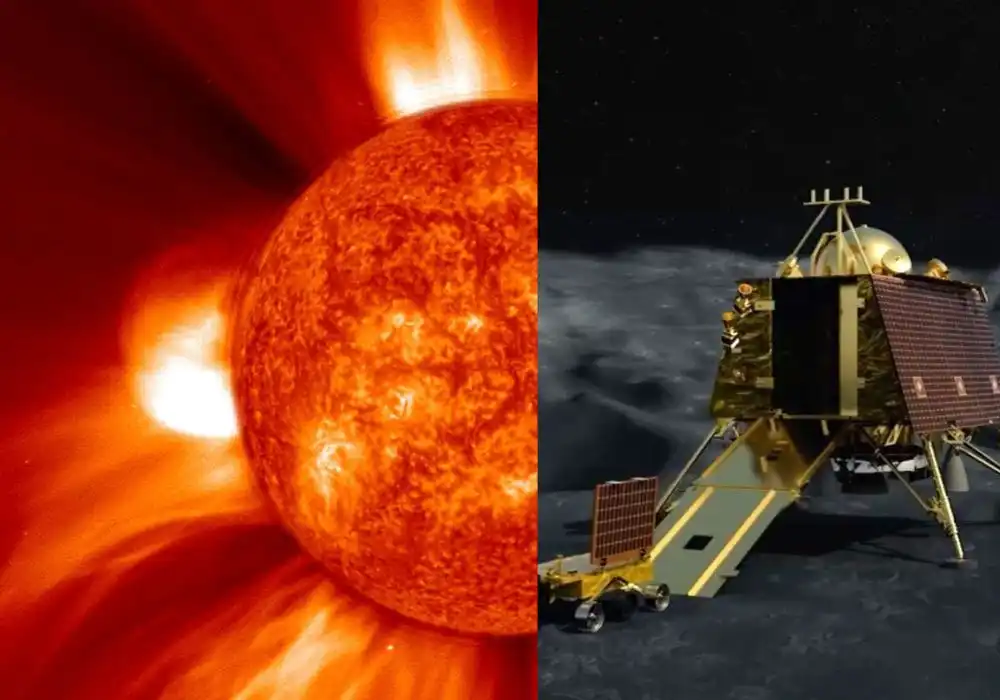
India’s ambitious Chandrayaan-2 mission continues to redefine our understanding of space, even years after its launch. In a remarkable feat of scientific observation, the mission has achieved a significant milestone by becoming the first ever to successfully detect and analyze the Sun’s Coronal Mass Ejections (CMEs) directly from the lunar surface. This isn’t just a win for ISRO; it’s a critical development for anyone tracking current affairs, space science, and general knowledge for competitive examinations like UPSC, SSC, PSC, NID, NIFT, and other government roles.
Unraveling Coronal Mass Ejections (CMEs)
To truly grasp the magnitude of Chandrayaan-2’s accomplishment, it’s essential to understand what Coronal Mass Ejections are. Imagine the Sun, our star, occasionally unleashing colossal bursts of plasma and magnetic fields into space. These are CMEs. They originate from the Sun’s outer atmosphere, the corona, and can travel millions of miles an hour. While beautiful, these solar storms can have significant impacts. When directed towards Earth, they can disrupt satellites, communication systems, power grids, and even pose risks to astronauts. Understanding their behavior is vital for protecting our technological infrastructure in space and on Earth.
Chandrayaan-2’s Historic Lunar Observation
How did Chandrayaan-2 achieve this unprecedented observation? The secret lies in its sophisticated onboard instrument, the Chandrayaan-2 Large Area Soft X-ray Spectrometer, or CLASS payload. While orbiting the Moon, CLASS detected energetic particles that are generated when CMEs interact with the lunar environment. This isn’t an easy task, as the Moon lacks a substantial atmosphere or a strong global magnetic field like Earth’s to deflect these particles. Thus, observing these events directly from the Moon provides a unique perspective. Previous missions have observed CMEs from Earth orbit or interplanetary space, but Chandrayaan-2 is the pioneer in making these observations specifically from the Moon’s proximity, offering invaluable data about how solar storms affect airless bodies.
The Profound Implications for Space Science
This groundbreaking detection by Chandrayaan-2 is more than just a scientific novelty; it has profound implications for future space exploration and our understanding of the solar system. By observing CMEs on the Moon, scientists can gain deeper insights into the space weather environment surrounding celestial bodies without substantial atmospheres. This data is crucial for planning future lunar missions, including crewed ones, by helping us understand the radiation risks astronauts might face. Moreover, it contributes significantly to a holistic understanding of the Sun’s influence on planetary environments, enabling us to better predict and mitigate the effects of solar storms across our solar system. For aspirants, this highlights India’s growing prowess in advanced space research and its contribution to global scientific knowledge.
Your Edge in Competitive Exams: Why This Matters for MyEntrance.in Users
For students diligently preparing for competitive exams, this Chandrayaan-2 achievement is a prime example of a “must-know” current affairs topic. It integrates multiple facets of general knowledge: space science and technology, India’s achievements, and global scientific advancements. Questions related to ISRO missions, specific payloads like CLASS, the definition and impact of CMEs, or the significance of lunar observations are highly likely to appear in examinations like UPSC, SSC, PSC, and other government recruitment tests. At myentrance.in, we ensure that such pivotal updates are seamlessly integrated into our daily news quizzes, current affairs sections, and static GK resources, providing you with interactive examinations and comprehensive answers to keep you ahead. Make sure to regularly check our platform for detailed analyses and practice questions on topics just like this.
Frequently Asked Questions (FAQs)
1. What is a Coronal Mass Ejection (CME)?
A CME is a massive burst of solar wind, plasma, and magnetic fields from the Sun’s corona that travels outward into space, often at incredibly high speeds.
2. Which instrument on Chandrayaan-2 detected the CMEs?
The Chandrayaan-2 Large Area Soft X-ray Spectrometer (CLASS) payload was primarily responsible for detecting the energetic particles associated with CMEs while orbiting the Moon.
3. Why is observing CMEs from the Moon considered a significant achievement?
It’s significant because Chandrayaan-2 is the first mission to observe CMEs directly from the lunar surface. This provides unique data on how solar storms affect airless celestial bodies, offering crucial insights for understanding radiation risks for future lunar missions and general space weather.
4. How does this discovery by Chandrayaan-2 benefit competitive exam aspirants?
This achievement is a vital current affairs topic, relevant for questions on space science and technology, ISRO’s accomplishments, and general knowledge in UPSC, SSC, PSC, and other government exams. It’s an excellent example of scientific breakthroughs from India.
5. Does the Moon have a strong magnetic field to protect it from CMEs like Earth?
No, unlike Earth, the Moon lacks a substantial global magnetic field or a dense atmosphere. This makes its surface and orbiting assets more directly exposed to solar wind and the energetic particles from CMEs.





