
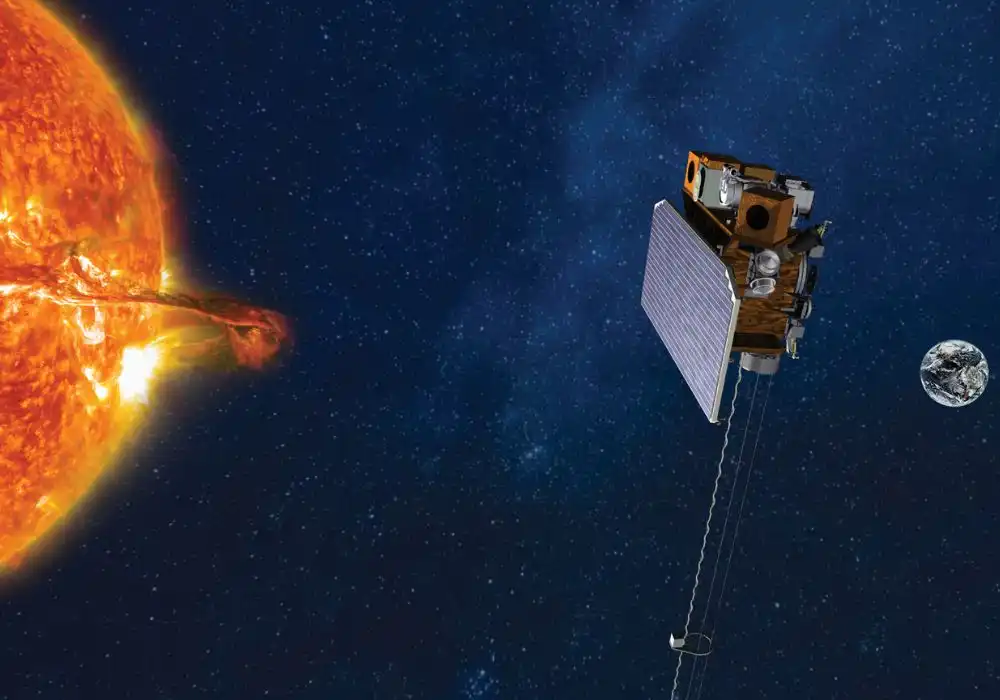
The cosmos is a dynamic place, and our Sun, a seemingly constant source of light and warmth, is also a powerful engine of change. It constantly sends out a stream of particles and magnetic fields known as solar wind, occasionally punctuated by explosive events like solar flares and coronal mass ejections. This phenomenon, collectively termed “space weather,” is far more than just a scientific curiosity; it’s a critical factor influencing everything from our global communication networks to power grids on Earth. For aspirants targeting prestigious exams like UPSC, SSC, PSC, NID, NIFT, and other government services, understanding these developments in space science is not just fascinating, but absolutely essential for acing current affairs, science & technology, and general knowledge sections. We provide concise and accurate daily GK updates for UPSC and PSC.
Understanding Space Weather: The Sun’s Influence on Our World
Space weather refers to the conditions in space that can affect Earth and its technological systems. It originates from the Sun, specifically from its dynamic and sometimes violent activity. Solar flares are sudden bursts of radiation, while coronal mass ejections (CMEs) are massive expulsions of plasma and magnetic field from the Sun’s corona. When these energetic particles and magnetic fields reach Earth, they can interact with our planet’s magnetosphere and atmosphere, leading to a variety of effects.
The importance of monitoring and predicting space weather cannot be overstated. Powerful solar storms can disrupt satellite operations, leading to outages in GPS navigation, satellite television, and global communication systems. They can also induce currents in long power lines, potentially causing widespread blackouts. Astronauts in space are at risk from increased radiation exposure during these events. Furthermore, the beautiful auroras, like the Northern and Southern Lights, are also a manifestation of space weather interacting with Earth’s magnetic field. For a well-prepared candidate, knowing the mechanics and implications of space weather is a key differentiator.
The Guardians of Space: NASA and NOAA’s Collaborative Missions
To better understand and predict the Sun’s behavior and its impact on Earth, leading space agencies like the National Aeronautics and Space Administration (NASA) and the National Oceanic and Atmospheric Administration (NOAA) are spearheading crucial missions. These collaborative efforts are designed to provide unprecedented insights into the origins of space weather and offer critical early warnings. Their joint ventures underscore a global commitment to protecting our technological infrastructure and enhancing our scientific knowledge of the Sun-Earth system.
One of the significant initiatives is the Interstellar Mapping and Acceleration Probe (IMAP), primarily a NASA mission. IMAP is designed to study the boundaries of our solar system, specifically the region where the solar wind interacts with the interstellar medium. By observing energetic particles and the heliosphere’s outer layers, IMAP aims to understand how the solar wind is shaped and how cosmic rays (another form of space radiation) penetrate our solar system. This foundational research is critical for deciphering the fundamental processes that drive space weather and its effects. Think of it as understanding the very source and initial conditions of the “weather system” before it even reaches Earth.
Complementing IMAP, NOAA is leading the Space Weather Follow On-Lagrange 1 (SWFO-L1) mission. Positioned at the Lagrange 1 (L1) point, a gravitationally stable location between the Sun and Earth, SWFO-L1 provides continuous, real-time observations of the solar wind and coronal mass ejections before they reach Earth. This strategic vantage point makes SWFO-L1 an invaluable early warning system. By detecting solar disturbances hours or even days in advance, it allows operators of satellites, power grids, and other critical infrastructure to take protective measures, mitigating potential damage. Its data is instrumental for operational space weather forecasting, making it a cornerstone for proactive defense against solar impacts.
While IMAP focuses on the broader interstellar environment influencing the solar system and SWFO-L1 on direct early warning, NOAA’s comprehensive space weather services also involve a network of Climate and Global Observing (CGO) systems. These include various ground-based observatories and other satellite assets that contribute to a holistic picture of solar activity and its propagation through space. This integrated approach, combining advanced scientific research with operational monitoring, ensures that our understanding of space weather is continuously refined and that society remains as prepared as possible for whatever the Sun might throw our way.
Why These Missions Matter for Your Exam Preparation
For aspirants, these missions represent more than just scientific achievements; they are prime examples of topics frequently covered in competitive examinations.
* Current Affairs: New mission launches, international collaborations, and scientific breakthroughs are regular features in current affairs sections. Knowing the names of the missions (IMAP, SWFO-L1), the agencies involved (NASA, NOAA), and their primary objectives is crucial.
* Science & Technology: These topics delve into space science, astrophysics, satellite technology, and the physics of solar phenomena. Questions might test your understanding of space weather’s effects, the importance of Lagrange points, or the purpose of specific instruments.
* General Knowledge: Awareness of significant global scientific endeavors and their societal impact is a staple of GK sections.
Staying updated on these developments showcases not only your knowledge but also your ability to connect scientific advancements with real-world implications, a skill highly valued in civil services and other competitive roles.
Conclusion
The collaborative efforts of NASA and NOAA through missions like IMAP and SWFO-L1 are pivotal in advancing our understanding of space weather and safeguarding our technologically dependent world. From unraveling the fundamental mysteries of the Sun to providing crucial early warnings, these endeavors protect our infrastructure, ensure astronaut safety, and deepen our cosmic comprehension. For every aspiring candidate, grasping the significance of these missions and their scientific context is an excellent way to enrich your knowledge base and significantly boost your performance in upcoming competitive examinations. Our platform offers essential daily current affairs practice questions for all aspirants.
Frequently Asked Questions (FAQs)
Q1: What exactly is space weather and why is it a concern?
A1: Space weather refers to the conditions in space, primarily driven by the Sun’s activity, that can affect Earth and its technological systems. It’s a concern because severe space weather events like powerful solar flares or coronal mass ejections can disrupt satellite communications, GPS, damage power grids, increase radiation risks for astronauts, and even affect aircraft navigation.
Q2: What are the main objectives of missions like IMAP and SWFO-L1?
A2: The main objectives are two-fold: IMAP aims to conduct fundamental scientific research by studying the boundary of our solar system (the heliosphere) and the processes that generate energetic particles, providing a deeper understanding of the origins of space weather. SWFO-L1, on the other hand, is an operational mission focused on providing real-time, early warnings of solar winds and coronal mass ejections heading towards Earth, allowing for proactive mitigation measures.
Q3: Where is the SWFO-L1 mission located and why is that important?
A3: The SWFO-L1 mission is positioned at the Sun-Earth Lagrange 1 (L1) point. This specific location is gravitationally stable and lies directly between the Sun and Earth. It’s crucial because from this vantage point, SWFO-L1 can observe solar storms and solar wind conditions *before* they reach Earth, providing several hours to days of advance warning.
Q4: Which major agencies are involved in studying and monitoring space weather?
A4: The primary agencies involved are NASA (National Aeronautics and Space Administration) and NOAA (National Oceanic and Atmospheric Administration) in the United States, often in collaboration with international partners. NASA typically focuses on fundamental space science research, while NOAA leads operational space weather monitoring, forecasting, and warning services.
Q5: How is knowledge of space weather relevant for competitive examinations like UPSC or SSC?
A5: Understanding space weather is highly relevant for competitive exams. It frequently appears in Current Affairs as a topic of scientific breakthrough and international collaboration. In Science & Technology sections, it tests knowledge of space science, astrophysics, and satellite technology. Furthermore, its real-world impact on infrastructure and daily life makes it a significant General Knowledge topic, demonstrating an aspirant’s awareness of global scientific developments and their implications.





