
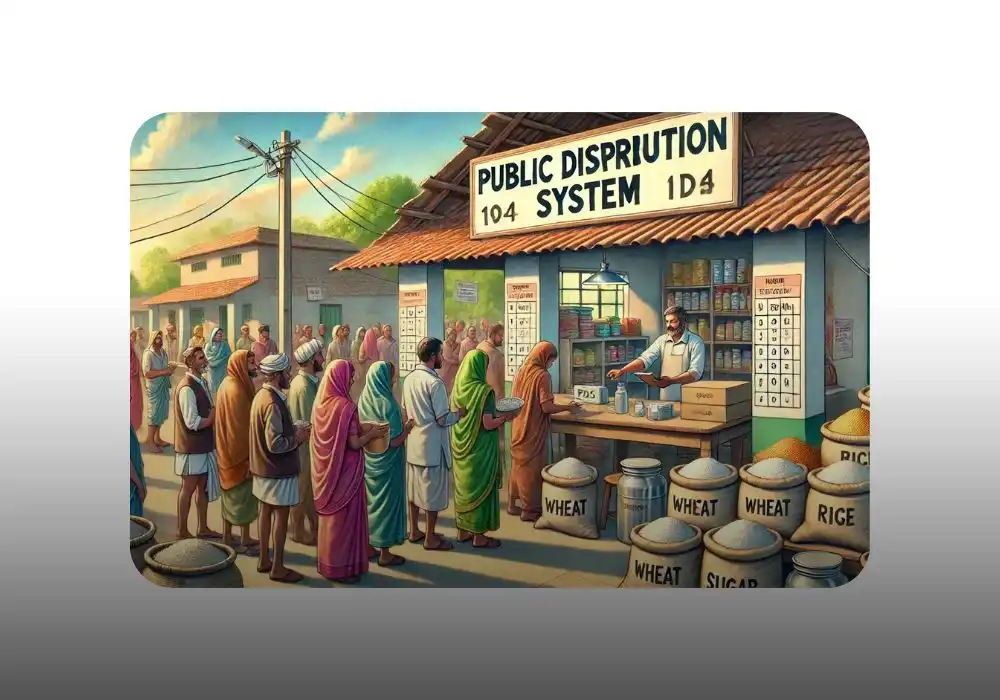
India, a nation continually striving to ensure access to adequate food for every citizen, places the Public Distribution System (PDS) at the heart of its social welfare initiatives. For aspirants preparing for competitive examinations like UPSC, SSC, various State PSCs, and other government roles, a deep understanding of PDS is not merely academic; it is about grasping a fundamental pillar of India’s social security framework. Recent discussions, significantly influenced by the Household Consumption Expenditure Survey (HCES) 2024, have reignited critical conversations about PDS’s efficacy, future reforms, and its pivotal role in achieving genuine food and nutrition security for millions. Boost your confidence right before the test with these proven quick prep tips for exams.
Understanding the Public Distribution System (PDS): Why It Exists
At its core, the Public Distribution System is a robust mechanism through which the government distributes essential food commodities, primarily rice, wheat, and sugar, to a large number of economically vulnerable families via an extensive network of Fair Price Shops (FPS). The fundamental objective of PDS is to manage food security for the poor by making essential food items available at highly subsidized prices. This strategic intervention protects citizens from market price volatility and ensures a baseline nutritional intake, acting as a crucial safety net, especially for the most vulnerable sections of society, shielding them from hunger and malnutrition. Tracing its roots back to rationing measures during World War II, PDS has evolved significantly over decades to become one of the largest food distribution networks globally. Go beyond rote learning by developing essential cognitive abilities for competitive exams.
The Journey and Core Objectives of PDS
From its inception, PDS has undergone several transformations, adapting to changing socio-economic realities. It initially operated as a universal entitlement scheme, but a significant policy shift occurred with the introduction of the Targeted Public Distribution System (TPDS) in 1997. This transformation aimed to focus benefits more precisely on specific below-poverty-line (BPL) and above-poverty-line (APL) categories, thereby enhancing the efficiency of subsidies. Regardless of these evolutions, the overarching objectives remain steadfast: to guarantee food security for the economically weaker sections, stabilize food prices across the market, and contribute significantly to poverty reduction by ensuring access to basic necessities. Understanding this historical evolution and the strategic shift towards targeting is crucial for comprehensive exam preparation.
PDS in Action: Achievements and Persistent Challenges
The indelible impact of PDS on mitigating food deprivation in India is widely acknowledged. It has been instrumental in averting widespread famine and ensuring a foundational level of food availability for millions, particularly during periods of economic distress or natural calamities. By providing consistently subsidized food grains, PDS has substantially enhanced food accessibility for impoverished households, leading to improved nutritional outcomes and a reduction in the severity of hunger.
However, despite its noble intentions and expansive reach, the system has been continuously confronted by several long-standing challenges. Prominent issues include significant *leakages* of food grains, where subsidized commodities are illicitly diverted to the open market instead of reaching the intended beneficiaries. *Inefficiencies* throughout the supply chain, from procurement and storage to final distribution, result in considerable wastage and escalate operational costs. A pervasive *cereal-centric bias* means the system predominantly focuses on rice and wheat, often overlooking the critical need for a diversified diet that includes pulses, millets, and edible oils, all essential for comprehensive nutrition security. Furthermore, persistent *targeting errors*—both inclusion (where the non-poor receive benefits) and exclusion (where the genuinely poor are left out)—continue to undermine the overall effectiveness and equity of the system. These challenges represent critical areas for administrative and policy reforms, frequently appearing as analytical questions in competitive examinations.
Charting a New Course: Insights for PDS Reform
The recent Household Consumption Expenditure Survey (HCES) 2024 provides invaluable fresh data and renewed impetus for a thorough examination and necessary reform of PDS. HCES offers crucial insights into contemporary consumption patterns and poverty levels, which are indispensable for fine-tuning targeting mechanisms and accurately assessing the actual impact of welfare schemes. By understanding the evolving household expenditure on food, policymakers can better tailor PDS provisions to meet current nutritional needs and economic realities.
Complementing this, the concept of the “Thali Index” offers another valuable analytical lens. While not an official government index, it is an economic indicator often used to gauge the affordability of a standard plate of food, reflecting food inflation and the common person’s purchasing power. Analyzing trends derived from such indices helps assess whether the subsidized food provided through PDS is truly adequate in terms of cost and nutritional value against the backdrop of overall food prices. Both HCES data and Thali Index insights guide us towards creating a PDS that is not only robust but also highly responsive to changing socio-economic landscapes.
Towards a Revitalized PDS: Key Areas for Transformation
Reforming PDS is a complex and multi-faceted challenge demanding a holistic and integrated approach. The strategic focus must shift from merely providing basic calories to ensuring comprehensive *nutrition security*. This entails diversifying the basket of commodities to include millets, pulses, and fortifying existing grains with essential micronutrients. Achieving *fiscal sustainability* is paramount, necessitating superior supply chain management, significant reduction of leakages through technology such as Aadhaar-enabled distribution, and optimized storage solutions. For truly *inclusive growth*, PDS must ensure that the most vulnerable populations, including tribal communities, internal migrants, and other marginalized groups, are effectively covered without errors of exclusion.
Leveraging advanced technology, such as biometric authentication at Fair Price Shops and end-to-end computerization of the entire supply chain, offers highly promising avenues to enhance transparency, minimize corruption, and improve accountability. Exploring innovative alternatives like direct cash transfers or food coupons in specific contexts, alongside strengthening the existing FPS network, could also form part of a comprehensive reform strategy. These vital areas are frequently tested in essay, general studies, and descriptive papers in examinations like UPSC and SSC.
Why This Topic Is Essential for Your Exams
For serious aspirants, a thorough and nuanced understanding of the Public Distribution System is absolutely indispensable. It directly connects to core subjects such as Indian Economy, Social Justice, Governance, and Current Affairs. Questions on PDS can encompass its historical evolution, current operational challenges, proposed policy reforms, and its profound socio-economic impact. Analyzing government reports, comprehending the role of various economic indices, and proposing practical, feasible solutions are critical skills frequently assessed in these high-stakes examinations. MyEntrance.in is committed to equipping you with the detailed knowledge and analytical framework required to excel in such challenging questions. Never miss an important event with our daily current affairs updates for exams.
Conclusion
The Public Distribution System stands as an enduring cornerstone of India’s unwavering commitment to food security for its vast population. While its contributions have been immense in feeding millions, the path forward unequivocally demands courageous and well-thought-out reforms that proactively address long-standing inefficiencies and adapt to the evolving nutritional needs of its citizens. By embracing cutting-edge, data-driven insights from sources like HCES 2024 and adopting innovative approaches to commodity delivery, India can transform its PDS into an even more effective and dynamic instrument for achieving true nutrition security, fostering inclusive growth, and ensuring a brighter, healthier future for all its citizens.
Frequently Asked Questions (FAQs)
1. What is the primary objective of India’s Public Distribution System (PDS)?
The primary objective of PDS is to ensure food and nutritional security for the poor and vulnerable sections of society by providing essential food commodities like rice, wheat, and sugar at highly subsidized prices through a network of Fair Price Shops, thus protecting them from price volatility and hunger.
2. How has the Public Distribution System (PDS) evolved in India since its inception?
PDS originated as a rationing measure during WWII and evolved into a universal system post-independence. A significant shift occurred with the introduction of the Targeted Public Distribution System (TPDS) in 1997, moving from universal entitlement to focusing on specific below-poverty-line (BPL) and above-poverty-line (APL) categories, aiming for better targeting of subsidies.
3. What are some key challenges currently facing the Public Distribution System (PDS) in India?
Major challenges include significant leakages of food grains into the open market, inefficiencies in storage and supply chain management leading to wastage, a “cereal-centric bias” that neglects diversified nutritional needs, and both inclusion and exclusion errors in identifying beneficiaries.
4. How do the Household Consumption Expenditure Survey (HCES) 2024 and the Thali Index contribute to PDS reform discussions?
The HCES 2024 provides up-to-date data on household consumption patterns and poverty, which is crucial for refining PDS targeting and commodity basket. The Thali Index, though an unofficial indicator, helps assess the real-world affordability of a basic meal, offering insights into the effectiveness of PDS in combating food inflation and ensuring adequate nutrition.
5. What reforms are being suggested to make PDS more effective and nutritionally secure?
Suggested reforms include diversifying the PDS basket to include millets, pulses, and fortified grains for enhanced nutrition security, improving supply chain efficiency and reducing leakages through technology (e.g., Aadhaar-enabled PDS), better targeting of beneficiaries, and exploring alternatives like cash transfers or food coupons in specific contexts to achieve fiscal sustainability and inclusive growth.





