
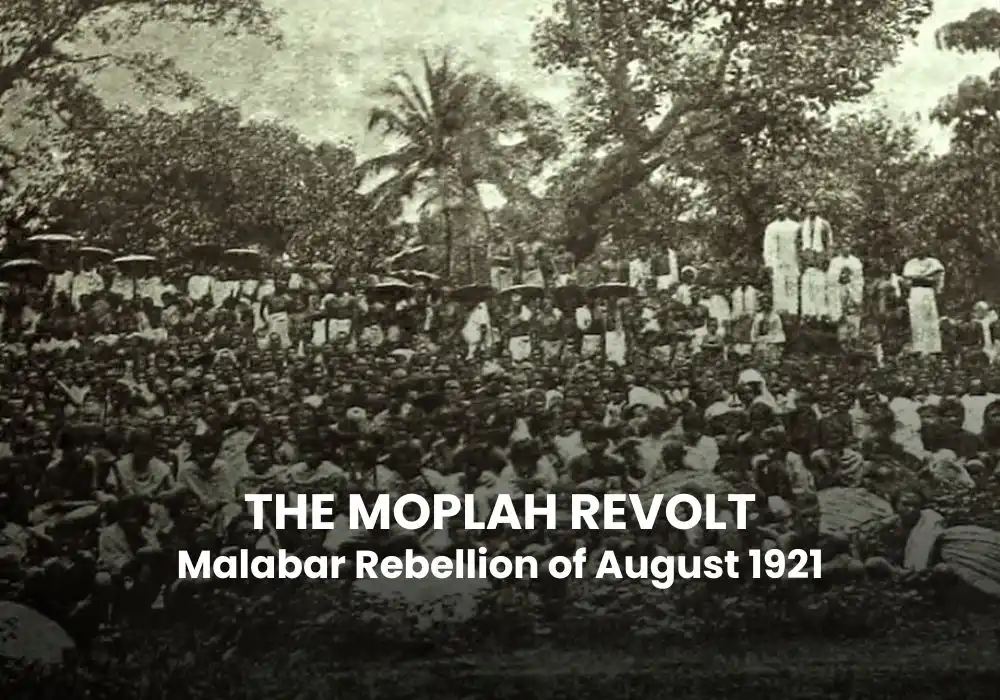
Welcome, aspiring civil servants and exam enthusiasts, to a crucial chapter in India’s freedom struggle that often sparks intense debate – the Moplah Revolt of 1921. At MyEntrance.in, we understand that mastering historical events like this, with their multifaceted causes and consequences, is key to acing competitive exams like UPSC, SSC, PSC, and various government recruitment tests. Far from being a simple uprising, the Moplah Revolt was a complex tapestry woven from agrarian discontent, religious fervor, and the broader currents of the anti-colonial movement. Let’s peel back the layers and understand this significant historical event comprehensively. Get exam-ready with our concise daily news summaries and quizzes.
The Malabar Uprising of 1921: Unpacking the ‘What’ and ‘When’
The Moplah Revolt, also widely known as the Malabar Rebellion, erupted in August 1921. It was not a sudden burst but the culmination of simmering tensions in the Malabar district of Kerala, a region then under British Madras Presidency. Essentially, it was a series of violent peasant uprisings by the Mappilas (also spelled Moplahs), the Muslim community of the Malabar region, against both the British authorities and the local Hindu landlords. This particular revolt stood out for its intensity and the severe communal turn it unfortunately took, making it a pivotal, albeit controversial, subject for detailed study.
The ‘Why’: Roots of Discontent – Agrarian Distress Meets Nationalist Fervor
To truly grasp the Moplah Revolt, we must understand its dual origins: deep-seated agrarian grievances and the potent influence of the Khilafat and Non-Cooperation Movements.
Agrarian Foundations: The Mappila community, largely tenant farmers and landless laborers, faced extreme exploitation under the prevailing land tenure system. The landlords, predominantly upper-caste Hindus known as ‘Jenmis’, held absolute ownership rights and were often absentee landlords. They imposed exorbitant rents, practiced arbitrary evictions without compensation, and subjected tenants to various forms of economic coercion. The Mappilas, despite cultivating the land for generations, had little to no security of tenure, leaving them perpetually vulnerable and resentful. This economic oppression formed the bedrock of their discontent.
The Catalyst: Khilafat and Non-Cooperation: The early 1920s saw India ablaze with the Khilafat Movement, a pan-Islamic political protest against the British dismantling of the Ottoman Caliphate, and Mahatma Gandhi’s Non-Cooperation Movement, which aimed for Swaraj. Both movements found strong resonance in Malabar. Mappila religious leaders and nationalist activists actively mobilized the community, linking their local grievances with the broader anti-British struggle and the call for religious justice. Gandhi’s initial support for the Khilafat cause fostered a brief period of Hindu-Muslim unity, but this also inadvertently emboldened the Mappilas, who saw the movements as an opportunity to address their long-standing suffering and, for some, to establish an Islamic state.
Key Figures and the Escalation: ‘Who’ Led the Way
The Moplah Revolt witnessed the rise of several influential local leaders who galvanized the community. Prominent among them were Variyamkunnath Kunjahammed Haji, Ali Musliyar, and Seethi Koya Thangal. Initially, the movement adopted a non-violent approach, influenced by the broader Non-Cooperation ideals. However, the oppressive actions of the British police and their heavy-handed attempts to suppress public meetings and arrest leaders quickly escalated the situation. When local authorities attempted to arrest Ali Musliyar in Tirurangadi, it ignited the powder keg, leading to a widespread armed uprising.
The ‘How’: Course of the Revolt and the British Response
Once ignited, the revolt spread rapidly. Mappila peasants, armed with traditional weapons, attacked police stations, government offices, British courts, and the houses of landlords and moneylenders. They seized weapons, destroyed records, and even declared a temporary “Khilafat kingdom” in certain areas, setting up their own administrative structures. For a short period, British authority crumbled in parts of Malabar.
The British response was swift and brutal. Martial law was declared, and thousands of troops were deployed. The rebellion was crushed with overwhelming military force. Key leaders were captured and executed, and thousands of Mappilas were arrested, imprisoned, or killed. A particularly tragic incident was the “Wagon Massacre” of November 1921, where over 60 Mappila prisoners being transported in a closed railway wagon suffocated to death. The brutal suppression and the ensuing communal violence left deep scars on the region.
The ‘Impact’: A Complex Legacy and Lessons for Today
The Moplah Revolt remains one of the most debated and controversial episodes in Indian history. While it undoubtedly began as an agrarian struggle against British imperialism and landlord exploitation, its trajectory took a distressing communal turn. As the revolt intensified, it saw attacks on Hindu landlords and, tragically, instances of forced conversions and violence against non-Mappila populations, leading to a breakdown of Hindu-Muslim relations in the region.
For competitive exams, understanding this complexity is paramount. Was it primarily a peasant uprising? Was it a communal riot? Or was it an integral, albeit flawed, part of the broader anti-colonial movement? Historians offer varied interpretations, and examining these different perspectives is crucial. The Moplah Revolt serves as a stark reminder of how local grievances can intertwine with national movements, sometimes with unforeseen and tragic consequences. It highlights the importance of studying history with nuance, acknowledging the multiple layers of cause and effect.
In contemporary discussions, the Malabar Revolt continues to be re-examined. A new book, “Musaliar King” by Abbas Panakkal, for instance, aims to shed further light on this pivotal but often overlooked resistance movement, urging us to reconsider its significance and the motivations of its participants. Understanding the Moplah Revolt provides critical insights into the socio-economic conditions of colonial India, the dynamics of peasant movements, and the challenges of forging unity in a diverse society. Avoid panic and optimize your final exam review with our expert advice.
Frequently Asked Questions (FAQs)
Q1: What were the primary causes of the Moplah Revolt of 1921?
A1: The revolt had two main causes: deep-seated agrarian distress among the Mappila peasants due to exploitative landlordism by Hindu Jenmis and the British, and the catalytic influence of the Khilafat and Non-Cooperation Movements, which imbued the struggle with a religious and anti-colonial fervor.
Q2: Who were the prominent leaders of the Moplah Revolt?
A2: Key leaders who emerged during the Moplah Revolt included Variyamkunnath Kunjahammed Haji, Ali Musliyar, and Seethi Koya Thangal. They played crucial roles in mobilizing the Mappila community against both the British and local landlords.
Q3: How did the Moplah Revolt become controversial and what was its communal aspect?
A3: While initially an agrarian and anti-British struggle, the revolt tragically devolved into communal violence. As British authority collapsed in some areas, some Mappila rebels targeted Hindu landlords, moneylenders, and even ordinary Hindus, leading to instances of forced conversions and widespread fear, which gave the revolt a strong communal dimension in its later stages.
Q4: What was the ‘Wagon Massacre’ associated with the Moplah Revolt?
A4: The ‘Wagon Massacre’ was a tragic incident in November 1921 where over 60 Mappila prisoners, being transported in a sealed and overcrowded railway wagon, suffocated to death due to lack of air. This event highlighted the brutal methods employed by the British to suppress the rebellion.
Q5: Why is the Moplah Revolt important for competitive exam preparation?
A5: The Moplah Revolt is significant for competitive exams because it illustrates the complex interplay of agrarian grievances, religious identity, and anti-colonial nationalism. It challenges simplistic narratives of the freedom struggle and requires candidates to understand the multi-faceted nature of historical events, including their social, economic, and political dimensions.
Excerpt
Dive into the Moplah Uprising of 1921, a pivotal and complex chapter in India’s freedom struggle. Uncover its roots in agrarian exploitation, the influence of the Khilafat Movement, key leaders, and its controversial communal turn. Essential for UPSC, SSC, and government exam aspirants, this deep dive at MyEntrance.in offers crucial insights into a historical event that continues to spark debate and shape our understanding of resistance.





