
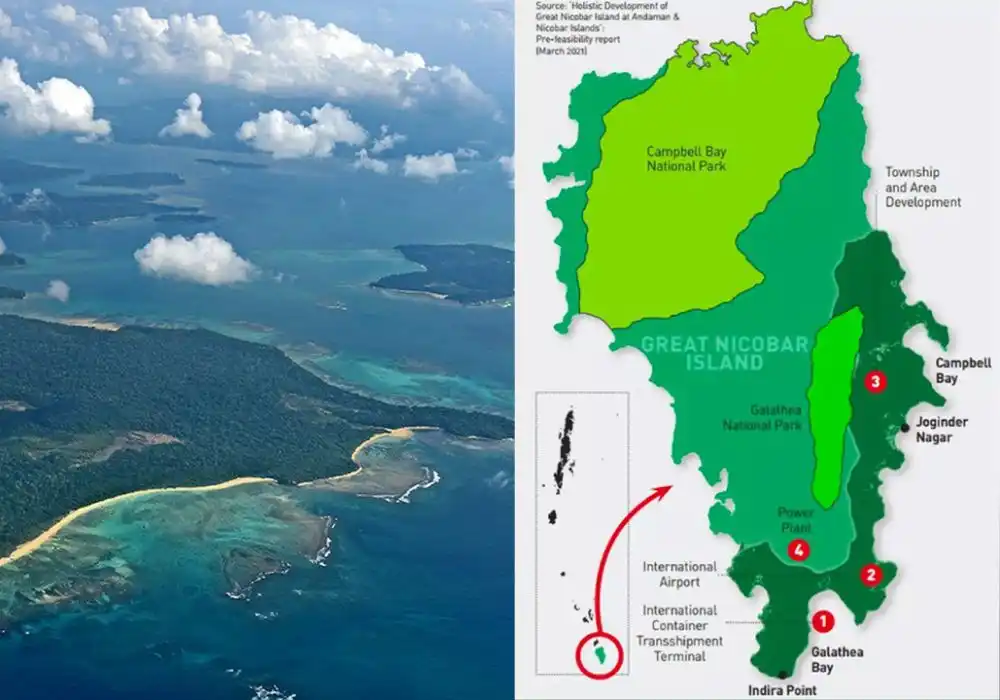
India’s ambitious Greater Nicobar Island Project envisions a futuristic international transshipment port, an airport, a power plant, and a greenfield township. This colossal undertaking, driven by strategic imperatives and economic aspirations, is poised to reshape regional dynamics and holds profound significance for every serious competitive exam aspirant. Understanding this multidisciplinary mega-project is not just about current affairs; it’s about grasping the intricate web of India’s strategic, environmental, and economic future. These emergency exam prep resources are designed for situations when time is limited.
The Vision Unveiled: What is the Greater Nicobar Project?
At its core, the Greater Nicobar Island Development Project is a multi-sectoral initiative conceptualized by NITI Aayog, aiming to transform a significant part of Greater Nicobar Island into a dynamic economic and strategic hub. The project encompasses several key components: an International Container Transshipment Port (ICTP) at Galathea Bay, a greenfield international airport, a power plant, and an industrial and residential township. This integrated development seeks to leverage the island’s unique geographical position in the Indian Ocean, unlocking its potential as a global maritime and economic gateway. With an estimated investment running into tens of thousands of crores, this project represents one of the largest infrastructure undertakings in India’s recent history, designed to bolster connectivity, trade, and national security.
Strategic Imperatives: Why Nicobar, Why Now?
The strategic location of the Andaman & Nicobar Islands, particularly Greater Nicobar, at the mouth of the Malacca Strait, is undeniably critical. This project directly feeds into India’s “Act East Policy” and the broader “SAGAR” (Security and Growth for All in the Region) doctrine, aiming to enhance India’s presence and influence in the Indo-Pacific. The proposed transshipment port at Galathea Bay is envisioned to rival established hubs like Singapore, Colombo, and Port Klang, reducing India’s reliance on foreign ports for cargo transshipment. From a defence perspective, the development strengthens India’s maritime domain awareness, projecting power and ensuring security across vital sea lanes of communication. This deepens India’s geopolitical standing, countering rising influence in the region and safeguarding national interests, making it a critical point of study for International Relations and Polity sections of exams like UPSC and PSC.
Economic Catalysts: Unlocking Potential and Challenges
Economically, the Greater Nicobar Project promises to be a game-changer. The International Container Transshipment Port is set to provide a significant boost to India’s maritime trade, attracting foreign investment, and generating substantial employment opportunities across various sectors including logistics, manufacturing, and tourism. It will create an ecosystem for robust industrial growth, making the island a hub for manufacturing and value-added services. Furthermore, the development of an international airport and improved infrastructure will enhance connectivity, stimulating economic activity and potentially positioning the region as a significant player in the blue economy. However, aspirants must also consider the economic challenges: the colossal investment required, the potential for project overruns, and the need for a sustainable economic model that benefits local communities without causing undue disruption. These aspects are vital for the Economy section of any competitive examination.
Environmental Crossroads: Development versus Conservation
The project’s location within a critically important biodiversity hotspot presents significant environmental and ecological considerations, making it a crucial topic for Environment and Geography segments of competitive exams. Greater Nicobar is home to the pristine Great Nicobar Biosphere Reserve, which includes the Campbell Bay National Park and Galathea National Park. These areas are vital habitats for endemic and endangered species, including the Nicobar Megapode, the Giant Leatherback Turtle (which nests in Galathea Bay), and a rich variety of flora and fauna unique to this region.
The project involves large-scale land conversion and potential ecological disturbance, raising concerns about deforestation, impact on marine ecosystems, and disruption to wildlife. Furthermore, the island is home to the Shompen, a Particularly Vulnerable Tribal Group (PVTG). Safeguarding their rights, culture, and traditional habitats amidst development is a paramount concern, often featuring in Mains examination questions on tribal welfare and sustainable development. Examining the environmental impact assessments (EIAs), compensatory afforestation plans, and the government’s approach to balancing development with conservation forms a vital part of exam preparation for UPSC and other government exams where environmental issues are prominent. Memorize the essential facts and figures for exam prep found in this compiled list.
Aspirant’s Advantage: Connecting the Dots for Your Exam
For competitive exam aspirants, the Greater Nicobar Project is a goldmine of interdisciplinary knowledge.
* Current Affairs & Daily News Quiz: Stay updated on project milestones, government approvals, environmental clearances, and any controversies. Our daily news quizzes on myentrance.in are designed to test your real-time knowledge.
* Geography: Understand the physiography of the Andaman & Nicobar Islands, its location relative to key shipping lanes, biodiversity hotspots, and the significance of specific locations like Galathea Bay.
* Environment & Ecology: Focus on the Great Nicobar Biosphere Reserve, endemic species (Megapode, Leatherback Turtle), the concept of PVTGs (Shompen), EIA processes, and the balance between development and conservation.
* Economy: Analyze the project’s potential for job creation, contribution to GDP, impact on maritime trade, competition with international ports, and the nuances of infrastructure development financing.
* Polity & Governance: Examine the role of NITI Aayog, the Union Territory administration, land acquisition policies, and the legal frameworks governing environmental protection and tribal rights.
* International Relations: Understand its implications for India’s Indo-Pacific strategy, maritime security, regional power dynamics, and the “Act East Policy.”
This topic serves as an excellent case study for Mains answer writing, requiring you to integrate knowledge from various subjects and present a balanced, analytical perspective. For preliminary exams, factual details about the project components, key locations, and associated species are frequently tested. Our interactive examinations provide a robust platform to test your understanding of such complex topics.
Sample Questions and Answers
Here are five sample questions to test your understanding of the Nicobar Mega Project, reflecting patterns seen in competitive exams:
1. Question: Consider the following statements regarding the Greater Nicobar Island (GNI) Development Project:
1. The project aims to develop an International Transshipment Port at Galathea Bay.
2. The Shompen tribe, a Particularly Vulnerable Tribal Group (PVTG), inhabits the island.
3. The project falls under the purview of India’s “SAGAR” vision.
Which of the statements given above are correct?
(a) 1 and 2 only (b) 2 and 3 only (c) 1 and 3 only (d) 1, 2 and 3
Answer: (d) 1, 2 and 3
*Importance for Exams:* This multi-statement question tests factual recall across different dimensions (economic, social, strategic) – a common UPSC preliminary pattern.
2. Question: The Greater Nicobar Island Development Project, particularly its initial conceptualization, was primarily spearheaded by which of the following organizations?
(a) Ministry of Shipping (b) Andaman & Nicobar Administration (c) NITI Aayog (d) Indian Navy
Answer: (c) NITI Aayog
*Importance for Exams:* This direct factual question is typical for SSC, PSC, and other government exams, focusing on key institutional roles.
3. Question: Galathea Bay, the proposed site for the International Transshipment Port in Greater Nicobar, is globally recognized as a significant nesting ground for which critically endangered species?
(a) Olive Ridley Turtle (b) Leatherback Turtle (c) Green Sea Turtle (d) Hawksbill Turtle
Answer: (b) Leatherback Turtle
*Importance for Exams:* This question combines geographical knowledge with environmental awareness, crucial for Environment & Ecology sections in various exams.
4. Question: The strategic location of the Greater Nicobar Island project is particularly significant in the context of which of India’s broader geopolitical strategies?
(a) Look West Policy (b) Belt and Road Initiative (c) Indo-Pacific Strategy (d) SAARC Cooperation
Answer: (c) Indo-Pacific Strategy
*Importance for Exams:* This question assesses understanding of India’s foreign policy and its connection to domestic development projects, relevant for IR and Current Affairs.
5. Question: A primary economic objective of developing an International Transshipment Port at Greater Nicobar is to:
(a) Promote local tourism extensively (b) Compete effectively with regional transshipment hubs like Colombo and Singapore (c) Establish a new naval base for defense (d) Primarily facilitate deep-sea fishing activities
Answer: (b) Compete effectively with regional transshipment hubs like Colombo and Singapore
*Importance for Exams:* This question delves into the core economic rationale and competitive aspect of the project, important for Economy and Current Affairs sections.
The Greater Nicobar Project is far more than an infrastructure scheme; it’s a litmus test for India’s aspirations in the 21st century. Mastering its nuances will undoubtedly equip you with a distinct advantage in your competitive exam journey.





