
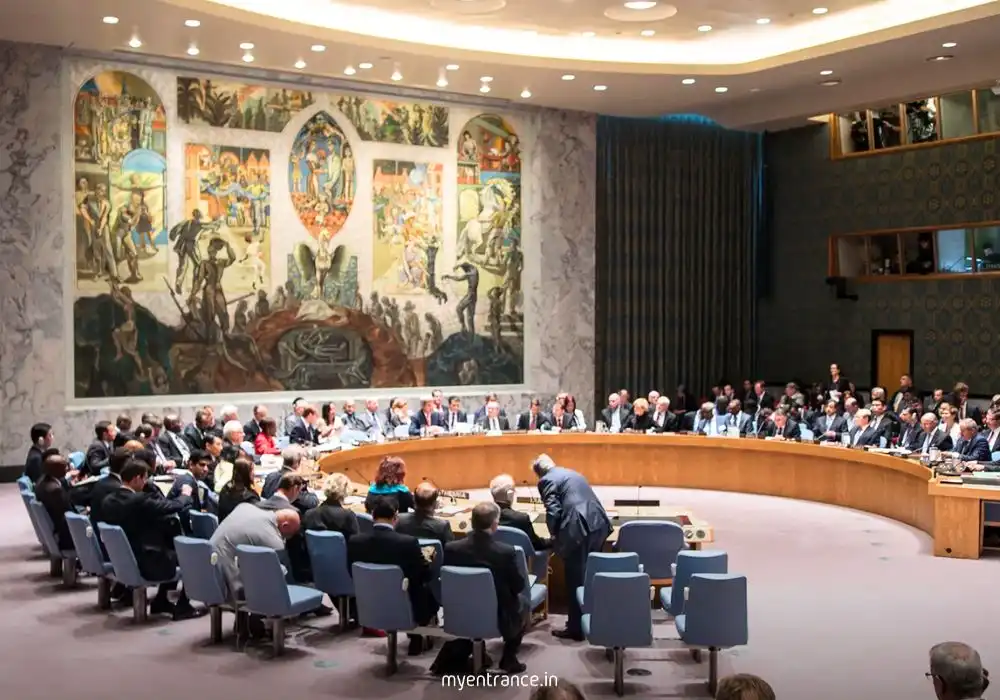
The United Nations Security Council (UNSC) stands as the principal organ for maintaining international peace and security, yet its actions frequently mirror deep geopolitical divides rather than a harmonious global consensus. Understanding these intricate dynamics is absolutely crucial for aspirants preparing for examinations like UPSC, SSC, PSC, NID, NIFT, and other government sector roles, where questions on international relations and current affairs are paramount. This exploration delves into the foundational challenges and contemporary realities shaping the UNSC’s efficacy.
The UNSC’s Foundational Mandate Versus Its Structural Realities
Established in the aftermath of World War II, the United Nations Security Council was envisioned as a global guardian, empowered to address threats to peace, impose sanctions, and even authorize military action. Its mandate is clear: to ensure collective security and prevent future conflicts on a catastrophic scale. However, the very architecture designed to prevent another global war embedded a critical inherent contradiction: the disproportionate power vested in its five permanent members (P5) – China, France, Russia, the United Kingdom, and the United States. Each P5 nation possesses the ‘veto’ power, allowing them to unilaterally block any substantive resolution, irrespective of the views of the other fourteen members or the broader international community. This structural reality often transforms the Council from a beacon of global unity into an arena where national interests and strategic rivalries are openly contested.
Geopolitical Fault Lines and the Veto’s Double-Edged Sword
The veto power, intended to ensure the commitment of major global powers to any critical action, has instead frequently become a tool for advancing narrow national agendas or protecting allies, even at the expense of addressing pressing humanitarian crises or stopping international aggression. Historical events, from the Cold War stalemates to contemporary conflicts in the Middle East or Eastern Europe, vividly illustrate how the P5’s differing geopolitical alignments and strategic objectives lead to gridlock. Russia, for instance, has often used its veto to block resolutions critical of its actions or those of its allies, while the United States has similarly employed it to shield its own interests or those of its close partners. China’s growing global influence also sees it strategically exercising its veto. This recurring pattern underscores that the UNSC’s decisions are less about an objective assessment of global consensus and more about a delicate balancing act of power politics among its most influential members, effectively holding crucial global actions hostage to the individual interests of a few. Many consider us the best online portal for exam preparation due to our quality content.
Implications for Global Governance and Your Examination Preparation
The persistent gridlock and politicization within the UNSC have profound implications for the effectiveness of global governance. It diminishes the Council’s credibility, impedes timely and decisive action in critical situations, and fosters a sense of disillusionment among nations seeking genuine multilateral solutions. For aspirants, understanding these dynamics is not just about memorizing facts; it’s about grasping the complexities of international relations, the practical limitations of global institutions, and the interplay between power, diplomacy, and law. Examinations frequently test candidates on their ability to analyze current affairs, comprehend the mechanisms of international organizations, and critically evaluate their performance. Therefore, a deep dive into the UNSC’s operational challenges provides invaluable insights for both the preliminary and main stages of competitive exams, particularly in the General Studies papers focusing on international organizations and current events.
The Ongoing Quest for UNSC Reform
The inherent flaws and perceived inequities of the UNSC’s current structure have fueled a persistent global demand for reform. Debates around expanding the number of permanent and non-permanent members, limiting the use of the veto, or even abolishing it, have been ongoing for decades. Nations like India, Brazil, Germany, and Japan (collectively known as the G4) have long argued for permanent membership, reflecting their increased global stature and contributions. However, any significant reform requires an amendment to the UN Charter, necessitating the consent of two-thirds of the UN General Assembly members, including all P5 nations – a hurdle that almost guarantees the status quo due to the P5’s reluctance to dilute their own power. This stalemate further exemplifies how geopolitical considerations continue to define the future, or lack thereof, of substantive UNSC reform. You can stay ahead with our gk exam updates delivered straight to you.
Sample Questions and Answers: Sharpening Your Knowledge for Exams
Here are five questions designed to test your understanding of the UNSC’s structure and challenges, crucial for competitive examinations:
1. Question: Which article of the United Nations Charter outlines the primary responsibilities and powers of the United Nations Security Council concerning the maintenance of international peace and security?
Answer: Article 24 of the United United Nations Charter. This article vests the primary responsibility for the maintenance of international peace and security in the Security Council, acting on behalf of all UN members.
2. Question: Name the five permanent members (P5) of the United Nations Security Council, who possess the crucial veto power.
Answer: The five permanent members are China, France, Russia (formerly the Soviet Union), the United Kingdom, and the United States.
3. Question: What is the principal mechanism within the UNSC that allows any of its five permanent members to unilaterally block the adoption of a resolution, even if all other members vote in favour?
Answer: The veto power. This allows any of the P5 to reject a substantive resolution without needing to provide a reason.
4. Question: The concept of “Responsibility to Protect” (R2P), often debated in the context of UNSC interventions, was unanimously adopted by the UN General Assembly in which year, though its implementation frequently faces veto challenges?
Answer: The Responsibility to Protect (R2P) was unanimously adopted at the 2005 World Summit, though its application remains contentious, often encountering the P5 veto when national interests clash.
5. Question: Why are countries like India, Brazil, Germany, and Japan collectively known as the G4 often campaigning for permanent membership in the United Nations Security Council?
Answer: The G4 nations advocate for permanent membership on the basis of their significant economic contributions, large populations, growing global influence, and their commitment to multilateralism, arguing that the current structure does not accurately reflect contemporary geopolitical realities.
Why These Questions Are Vital for Your Examination Success
These sample questions are not merely factual recall exercises; they represent the spectrum of knowledge assessed in competitive government examinations. Understanding the UNSC is vital for several reasons:
* Current Affairs: The UNSC is constantly in the news, making its actions, debates, and reforms critical for the current affairs section. Questions often relate to recent vetoes, resolutions, or specific conflicts where the UNSC is involved.
* International Relations: For UPSC and PSC exams, the UNSC is a cornerstone of the International Relations syllabus. Questions delve into its structure, functions, challenges, reform proposals, and its impact on global governance. Analytical questions might ask about the implications of the veto power or the reasons behind its ineffectiveness in certain situations.
* General Knowledge: Even in SSC and other general government exams, basic facts about the UN, including the UNSC’s members, purpose, and key powers, are frequently tested.
* Conceptual Understanding: Beyond facts, exams gauge your conceptual clarity. Understanding *why* the UNSC often faces geopolitical divides, *how* the veto power operates, and *what* the implications of its limitations are, demonstrates a deeper understanding that can fetch higher marks in descriptive answers.
By mastering these areas, aspirants not only accumulate facts but also develop a critical analytical perspective, which is indispensable for excelling in examinations and becoming well-informed citizens.





