Translate Language
Onam Festival: What is the Profound Mythological Significance Behind Kerala’s Grand Celebration?
Onam is far more than Kerala’s vibrant harvest festival; it is a cultural narrative etched in mythology and societal values. The celebration commemorates the annual homecoming of the revered King Mahabali, a symbol of a golden era of equality and prosperity. Its core story and traditions offer timeless lessons highly pertinent to the governance and social ethics topics in competitive examinations.
The History and Significance of Onam:
The festival of Onam is a magnificent tapestry woven with threads of mythology, agrarian culture, and profound social symbolism. At its heart lies the legend of the Asura king, Mahabali, whose reign was a golden period of unparalleled justice and prosperity, where crime and sorrow were unknown. Feeling threatened by his virtuous rule, the Devas appealed to Lord Vishnu, who incarnated as Vamana, a dwarf Brahmin. During a grand sacrifice, Vamana requested a simple gift of three paces of land. The generous Mahabali agreed without hesitation, only to witness Vamana expand into a cosmic form, covering the entire earthly realm in one step and the heavens in the next. With no space left for the third step, the righteous king offered his own head, an ultimate act of sacrifice and honouring one’s word.
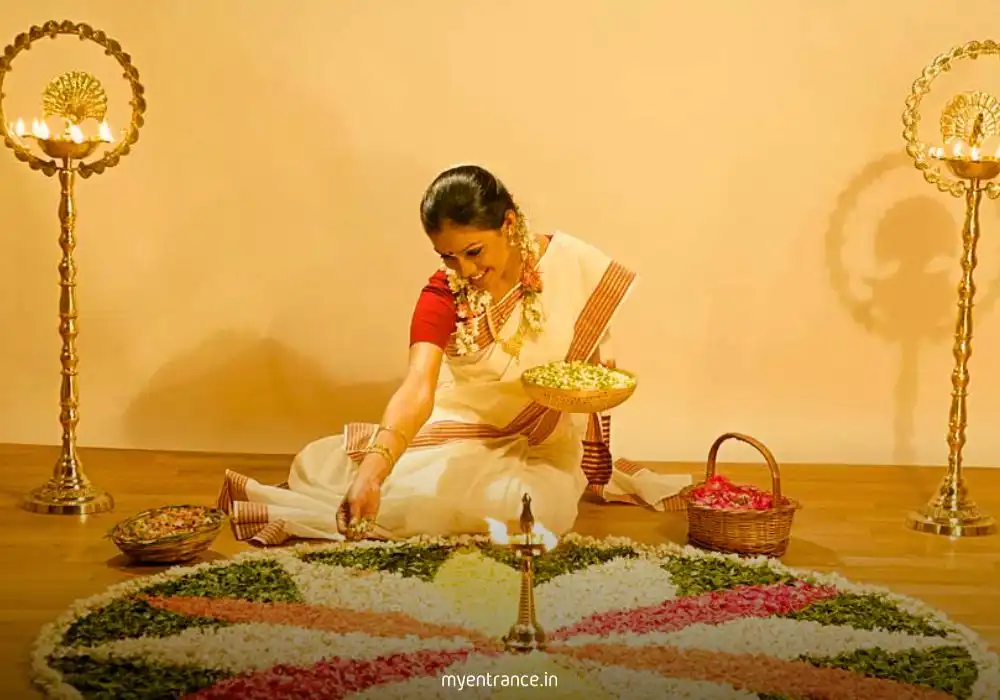
Impressed by this devotion and integrity, Vishnu granted Mahabali a boon, allowing him to return annually to visit his beloved subjects. This homecoming is celebrated as Onam. The festival, therefore, transcends a mere harvest celebration; it signifies the eternal yearning for a utopian society based on equality (unity in diversity), righteous governance (a key governance metric), and the ultimate victory of devotion over power. The elaborate Onasadya feast, the intricate Pookalam floral arrangements, and the energetic Vallam Kali boat races are not just rituals but vibrant expressions of this shared cultural memory and joy.
Questions and Answers from this Article
1. Onam is primarily associated with the annual homecoming of which legendary king?
Onam is celebrated to mark the annual homecoming of the legendary King Mahabali, who was known for his just and benevolent rule.
2. Which avatar of Lord Vishnu is central to the mythological story of Onam?
The Vamana avatar, the dwarf Brahmin incarnation of Lord Vishnu, is central to the story of how King Mahabali was tested.
3. What was the boon granted to King Mahabali by Lord Vishnu?
Impressed by Mahabali’s devotion and sacrifice, Lord Vishnu granted him the boon to visit his kingdom and people once every year.
4. Beyond mythology, what is the other key aspect that Onam celebrates?
Onam is also a major harvest festival, celebrating the year’s abundance, prosperity, and the arrival of the new harvest season.
5. Name two traditional cultural activities performed during Onam celebrations.
Two prominent activities are the creation of Pookalam (intricate floral carpets) and the performance of Pulikali (the tiger dance).
6. What core social value does the reign of King Mahabali represent?
His reign represents the core social values of unity, equality, and the ideal of a prosperous and just society for all.
7. What was the simple request made by Vamana to King Mahabali?
Vamana requested a gift of three paces of land from the generous king.
Why is this Topic Important for SSC, UPSC, PSC, and Other Government Exams?
Understanding the history and significance of Onam is crucial for aspirants for several reasons. Firstly, questions on important Indian festivals, their cultural context, and associated legends are a staple in the General Awareness and Static GK sections of most competitive exams. Secondly, the story of Onam is a rich source for essay topics and ethics case studies (particularly for UPSC), dealing with themes like ideal governance, sacrifice, integrity, and the spirit of inclusivity. Thirdly, examiners often draw connections between traditional practices and their contemporary relevance; for instance, Onam’s message of equality can be linked to social justice questions. Finally, for Kerala PSC and other state-level exams, in-depth knowledge of the state’s premier festival is absolutely essential and can be the differentiator in the final selection.
Read More Topics