Translate Language
What is Project Kusha and How Will It Secure India’s Skies by 2035?
India is poised to take a monumental leap in its air defence capabilities with the upcoming testing of new long-range interceptor missiles. This initiative, a critical part of the indigenous Project Kusha, seeks to create a robust defensive shield over the nation’s vital areas. The project represents a strategic imperative for self-reliance in defence technology and national security.
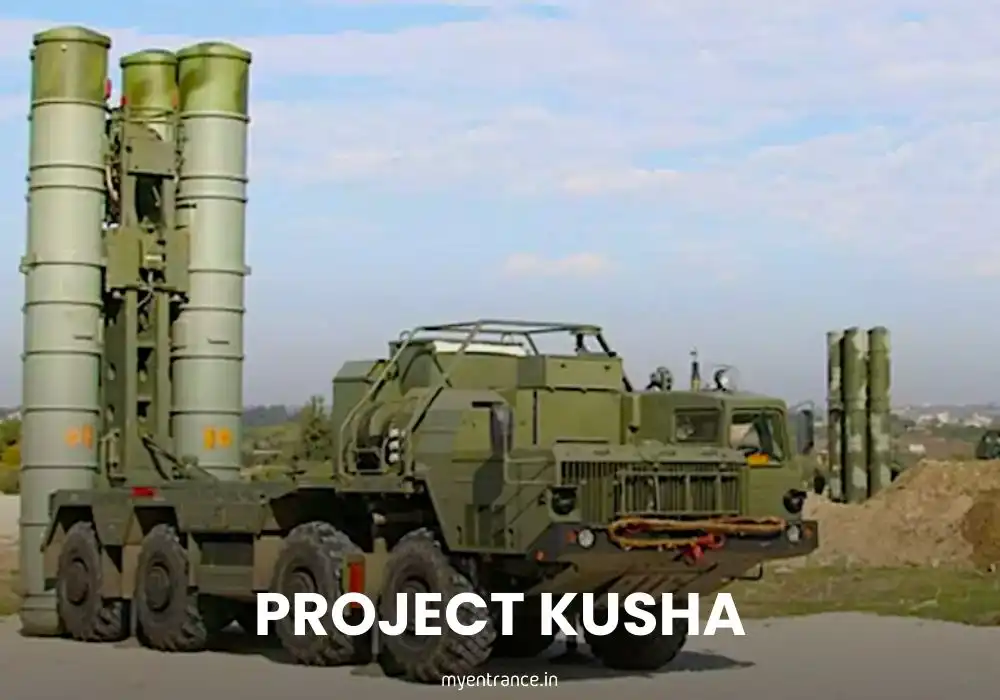
Decoding Project Kusha: India’s Strategic Shield for the Skies
For aspirants preparing for competitive examinations, understanding India’s defence projects is not just about current affairs; it’s about comprehending the nation’s strategic posture. Project Kusha, operating under the broader umbrella of Mission Sudarshan Chakra announced by Prime Minister Modi, is one such pivotal initiative. The primary objective of this project is to develop and deploy a fully automated, multi-layered Long-Range Surface-to-Air Missile (LR-SAM) system. This system is designed to provide comprehensive security cover to India’s strategic installations and vital civilian areas against a spectrum of aerial threats, with a targeted completion horizon of 2035.
LEARN MORE: Op Sindoor Aftermath: Defence Proposals Worth ₹1 Lakh Crore
The core ambition is to achieve a high degree of indigenization, reducing reliance on foreign defence imports. Developed by the Defence Research and Development Organisation (DRDO), the project aims to field a system that rivals the capabilities of advanced systems like the Russian S-400 Triumf, but built on Indian soil. This aligns with the ‘Atmanirbhar Bharat’ (Self-Reliant India) vision in the critical defence sector. Furthermore, the project is not conceived as a purely defensive shield. As highlighted by the Chief of Defence Staff, General Anil Chauhan, the system is designed for a proactive defence doctrine, meaning it will possess the capability to not only intercept incoming threats but also to launch counter-strikes, thereby delivering a significantly potent response to any adversary.
The technological execution of this vision involves the development and sequential testing of three distinct interceptor missiles, each creating a specific layer of defence. The first missile, designated M1 with an engagement range of 150 kilometres, is slated for testing in 2026. It is designed to neutralize closer-range threats such as enemy aircraft, cruise missiles, and drones. This will be followed by the M2 missile in 2027, which extends the protective bubble to 250 kilometres. The final and most formidable layer will be the M3 missile, with a 350-kilometre range, scheduled for testing in 2028. This three-tiered structure ensures that threats are engaged and destroyed at the most optimal distance, far away from their intended targets, creating a formidable defensive grid akin to Israel’s Iron Dome or the proposed American Golden Dome initiative, but on a much larger scale.
LEARN MORE: Defence Deals 2025: How India is Shaping Global Military Diplomacy
Crucial Questions on Project Kusha for Your Competitive Exams
1. What is the overarching goal of Mission Sudarshan Chakra under which Project Kusha operates?
The overarching goal of Mission Sudarshan Chakra is to build an integrated, multi-layered air and missile defence shield around India’s key strategic and civilian locations. It is a holistic initiative to achieve comprehensive aerial dominance and security.
Exam Importance: Questions on flagship defence missions are common. Understand the difference between a project (Kusha) and a mission (Sudarshan Chakra).
2. Which organization is responsible for the development of the LR-SAM systems under Project Kusha?
The Defence Research and Development Organisation (DRDO) is the premier agency developing the long-range surface-to-air missiles and the associated systems for Project Kusha.
Exam Importance: Linking key defence projects with their executing agencies (e.g., DRDO, ISRO, HAL) is a fundamental requirement for exams.
3. Differentiate between the operational roles of the M1 and M3 interceptor missiles.
The M1 missile, with a 150 km range, is designed as the inner layer of defence, primarily engaging shorter-range threats like cruise missiles and drones. The M3 missile, with a 350 km range, acts as the outer layer, designed to engage high-value targets like enemy aircraft and ballistic missiles at long distances, far before they can pose a immediate threat.
Exam Importance: This tests analytical understanding of defence strategies (multi-layered defence) and specific technical knowledge.
4. How does Project Kusha align with the Indian government’s broader policy objectives?
Project Kusha is a direct embodiment of the ‘Atmanirbhar Bharat’ (Self-Reliant India) policy in the defence sector. It aims to achieve self-sufficiency in critical defence technology, reduce foreign dependency, and boost the domestic defence manufacturing ecosystem.
Exam Importance: Connecting current projects to national policies demonstrates a deeper, analytical grasp of governance and current events, crucial for essay and interview stages.
5. What is the strategic significance of the system having a “proactive defence doctrine”?
A proactive defence doctrine, as stated by the CDS, means the system is not merely passive. It is designed to also launch counter-strikes against an adversary’s launch points or assets. This serves as a strong deterrent and enhances India’s second-strike capability.
Exam Importance: Understanding military doctrines and terminologies is key for questions related to national security, defence, and internal security topics.
6. Name one international air defence system that Project Kusha is expected to rival.
Project Kusha is expected to rival the capabilities of the Russian-origin S-400 Triumf air defence system.
Exam Importance: Comparative knowledge of Indian and international defence systems is often tested in UPSC and other SSC CGL (General Awareness) exams.
7. By which year is the induction of the complete Project Kusha system targeted?
The development and testing phase is aimed to be completed by 2028, paving the way for the induction of the systems into the armed forces from 2030 onwards.
Exam Importance: Specific timelines and deadlines related to major government projects are high-yield facts for objective-type questions.
Read More Topics