
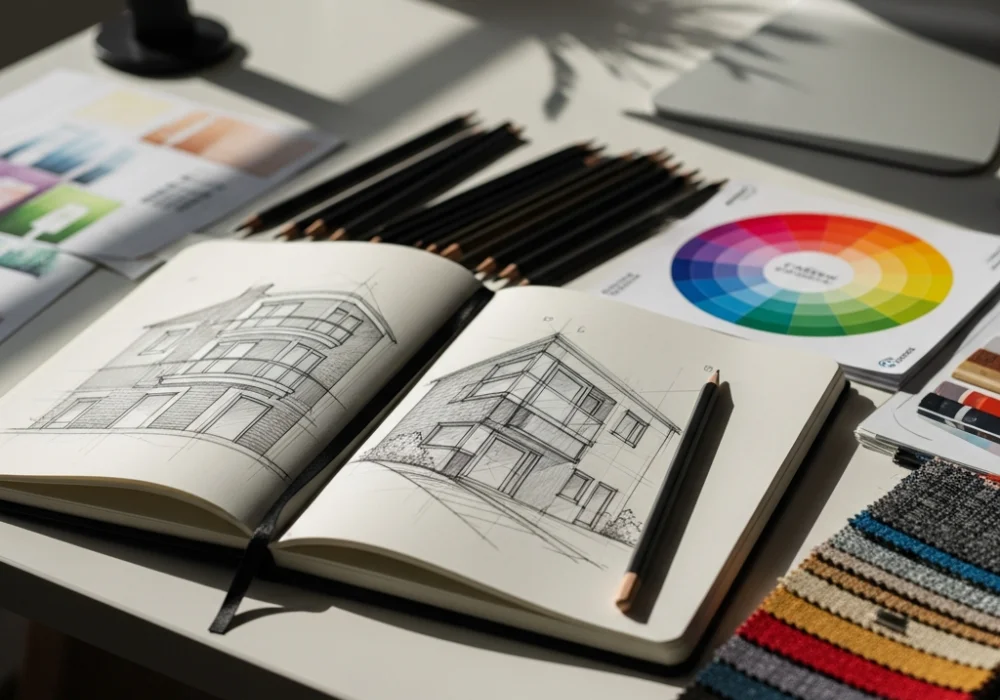
Mastering the NIFT Creative Ability Test (CAT) Through Expert Sketching
The National Institute of Fashion Technology (NIFT) is the premier destination for design aspirants. To secure a seat, students must navigate the Creative Ability Test (CAT), a segment designed to evaluate intuition, power of observation, and design innovation. Unlike technical drawing, the CAT requires a blend of artistic flair and conceptual clarity. At myentrance.in, we provide the resources and mock tests necessary to transform your raw talent into a professional design portfolio. In this guide, we dive deep into the seven essential sketching techniques that will help you stand out in the latest pattern of the NIFT entrance exam.
1. Perfecting Linear and Aerial Perspective
Perspective is the foundation of any realistic sketch. In the NIFT CAT, you are often asked to draw scenes from daily life, such as a busy market or a room interior. Understanding 1-point, 2-point, and 3-point perspective is non-negotiable. One-point perspective is ideal for straight-on views like hallways. Two-point perspective allows you to draw corners of buildings or objects at an angle, providing a sense of 3D depth. Furthermore, aerial perspective involves using lighter strokes and less detail for objects further away, mimicking how the human eye perceives distance. This technique adds a professional layer of realism to your compositions.
2. Human Anatomy and Proportions
Whether you are designing a garment or illustrating a scene, human figures are frequently required. NIFT examiners look for correct proportions rather than hyper-realistic faces. Start by practicing the ‘8-head’ or ‘9-head’ theory used in fashion illustration. Begin with a basic stick figure to establish the pose and movement, then add flesh and clothing. Focusing on the ‘line of action’ helps in creating dynamic poses that look natural rather than stiff. Regular practice with the mock tests on myentrance.in can help you master drawing figures within the exam’s time constraints.
3. Mastering Light and Shadow
Shading is what gives your 2D sketch a 3D volume. To ace the CAT, you must understand the light source’s direction. Consistency is key; if your light is coming from the top-left, all shadows must fall toward the bottom-right. Use a range of pencils (from HB to 6B) to create a gradient of values. Techniques like hatching, cross-hatching, and stippling can be used to indicate different textures and depths. Avoid smudging with your fingers, as it can make the sketch look messy; instead, use controlled strokes to build up the dark areas.
4. Material and Texture Rendering
A designer must be able to communicate what a product is made of through their drawing. NIFT often asks students to design products or clothing where texture is vital. You should practice rendering various materials:
- Glass: Focus on highlights and sharp reflections.
- Wood: Use organic, wavy lines and knots.
- Metal: High contrast between deep blacks and bright whites.
- Fabric: Focus on folds, drapes, and the weight of the material.
5. Composition and the Rule of Thirds
How you place elements on your paper matters as much as the quality of the sketch. Avoid placing your main subject dead-center. Instead, use the Rule of Thirds: imagine your paper divided into a 3×3 grid and place your focal points along the lines or at their intersections. This creates a more balanced and visually appealing composition. Always leave some ‘negative space’ to prevent the drawing from looking cluttered, and ensure there is a clear foreground, middle ground, and background.
6. Rapid Sketching and Time Management
The NIFT CAT is a race against time. You might have several questions to answer in a limited window. Developing the skill of rapid sketching allows you to jot down multiple ideas before committing to one. Practice ‘thumbnail sketching’—small, quick versions of your final idea—to decide on the best composition. Using the current syllabus-based mock tests on myentrance.in is the best way to simulate the pressure of the exam hall and improve your speed without sacrificing quality.
7. Effective Use of Color Theory
While pencil sketching is vital, many CAT questions allow or require color. Understanding the color wheel is essential. Use complementary colors (opposite on the wheel) for high contrast and analogous colors (next to each other) for harmony. When using dry mediums like pencil colors or markers, practice layering and blending to create smooth transitions. Remember, color should enhance your design, not overpower it. Use vibrant hues for the focal point and muted tones for the background.
Comparing Sketching Mediums for NIFT
Choosing the right medium can affect your speed and the final look of your work. Here is a quick comparison:
| Medium | Best For | Pros | Cons |
|---|---|---|---|
| Graphite Pencils | Shading & Detailing | Precision and control | Can smudge easily |
| Color Pencils | Product Design | Great for layering | Time-consuming for large areas |
| Brush Pens/Markers | Fashion Illustration | Vibrant and fast coverage | Difficult to correct mistakes |
| Charcoal Pencils | Dramatic Effects | Deep blacks and textures | Very messy for exam conditions |
Practice with myentrance.in Mock Tests
Theory alone isn’t enough to clear the NIFT entrance exam. You need consistent practice and feedback. myentrance.in offers a comprehensive suite of mock tests designed specifically for the latest pattern of NIFT CAT and GAT. These tests help you understand the types of questions asked, from creative writing to innovative product design, ensuring you are fully prepared for the upcoming exams.
Frequently Asked Questions (FAQ)
Which pencils are best for the NIFT CAT?
A set of high-quality graphite pencils ranging from HB to 6B is recommended. HB is great for initial outlines, while 2B to 6B are excellent for shading and adding depth.
Can I use watercolors in the NIFT entrance exam?
Generally, dry mediums like color pencils, oil pastels, or plastic crayons are preferred because the paper provided might not handle heavy water washes well. Check the specific instructions in your admit card for the current syllabus requirements.
How can I improve my sketching speed?
Set a timer and practice daily. Start with 10-minute sketches of objects around you. Gradually reduce the time as you become more comfortable with proportions. Mock tests on platforms like myentrance.in are also great for timed practice.
Is it necessary to be a professional artist to crack NIFT?
No, NIFT looks for creativity and the ability to communicate ideas visually. As long as your sketches are neat, proportional, and innovative, you have a high chance of succeeding.
🚀 Ready to Ace Your NIFT Entrance?
Don’t leave your preparation to chance. Get expert guidance and access to premium mock tests today!
💬 Chat with our Experts on WhatsApp (+91 9526806124)




