
Mastering the Art of Sketching for the NIFT Creative Ability Test
For every design aspirant dreaming of a seat at the National Institute of Fashion Technology (NIFT), the Creative Ability Test (CAT) is the ultimate hurdle. Unlike academic exams, the CAT evaluates your intuition, observation skills, and creative execution. While many focus on expensive coaching, the secret to success lies in the consistency of your daily sketching exercises. Sketching is not just about drawing a pretty picture; it is about communicating an idea effectively on paper.
At myentrance.in, we understand that practice makes perfect. Our platform offers comprehensive mock tests that mimic the latest pattern of the NIFT entrance exam, providing you with the real-time feedback needed to improve. In this guide, we will explore ten vital exercises that every NIFT aspirant should incorporate into their daily routine to build a professional-level portfolio and excel in the exam.
Table of Contents
- Exercise 1: Blind Contour Drawing for Hand-Eye Coordination
- Exercise 2: Gesture Drawing and Human Anatomy
- Exercise 3: One, Two, and Three-Point Perspective
- Exercise 4: Textural Rendering and Materiality
- Exercise 5: Rapid Memory Sketching
- Exercise 6: Object Proportions and Still Life
- Exercise 7: Light, Shadow, and Value Studies
- Exercise 8: Stick Figure to Fashion Croquis
- Exercise 9: Composition with Geometric Shapes
- Exercise 10: Narrative Storyboarding
- Sketching vs. Rendering: A Comparison
- Frequently Asked Questions
- Quick Knowledge Check
1. Blind Contour Drawing for Hand-Eye Coordination
Blind contour drawing is an essential exercise where you look at an object and draw its outline without looking at your paper. This might sound counterintuitive, but it forces your brain to sync your hand movements with your eyes. It prevents you from drawing what you ‘think’ an object looks like and instead makes you draw what you actually ‘see’.
How to do it: Pick a complex object like a bunch of keys or your own hand. Set a timer for 5 minutes. Focus your eyes on the edge of the object and move your pencil at the same speed your eyes move. Do not lift the pencil.
💡 Click to Reveal Pro-Tip
Try this exercise for 10 minutes every morning. It reduces the ‘stiffness’ in your lines and makes your sketching more fluid, which is highly valued in the NIFT CAT section.
2. Gesture Drawing and Human Anatomy
The NIFT CAT often requires drawing humans in various scenes, such as a busy market or a railway station. Gesture drawing helps you capture the essence of movement and posture without getting bogged down in details. You need to capture the ‘action’ in less than 60 seconds.
- Focus on the line of action (the spine).
- Use loose, sweeping strokes.
- Practice drawing people from live observation in parks or cafes.
Understanding anatomy is crucial. Ensure you know the basic proportions: the average human body is roughly 7.5 to 8 heads tall. Practicing this daily will ensure your figures don’t look robotic in the exam.
3. One, Two, and Three-Point Perspective
Perspective is the backbone of design drawing. NIFT frequently asks students to design a room, a street view, or a futuristic vehicle. Without a solid grasp of perspective, your drawings will lack depth and realism.
- One-Point Perspective: Used for looking straight at a scene (e.g., a hallway).
- Two-Point Perspective: Used for objects seen from a corner (e.g., a building from the street).
- Three-Point Perspective: Used for worm’s eye or bird’s eye views.
Spend 20 minutes daily drawing cubes and cylinders in different perspectives. This technical foundation is a massive differentiator in the scoring criteria of the entrance exam.
4. Textural Rendering and Materiality
In the design world, being able to differentiate between silk, wood, glass, and metal on paper is a high-level skill. In your exam, you might be asked to design a product using specific materials. Your sketch must communicate the texture visually.
Practice Table: Texture Techniques
| Material | Rendering Technique | Key Feature |
|---|---|---|
| Polished Metal | High contrast, sharp highlights | Reflectivity |
| Soft Silk | Smooth gradients, fluid folds | Lustre |
| Rough Wood | Cross-hatching, irregular lines | Grain detail |
| Transparent Glass | Subtle outlines, refracted light | Transparency |
5. Rapid Memory Sketching
Memory drawing is a staple in NIFT CAT. You might be asked to sketch a scene from a local vegetable market or a scene of a person waiting at a doctor’s clinic. Since you won’t have a reference photo in the exam hall, you must build a visual library in your head.
The Daily Drill: Look at a photograph or a real-life scene for 2 minutes. Close your eyes/put the photo away and try to recreate the entire scene with details like background objects, clothing, and expressions. This exercise trains your brain to retain visual information.
6. Object Proportions and Still Life
Drawing everyday objects—a stapler, a water bottle, or a pair of spectacles—requires an understanding of proportions. If the proportions are off, the design looks amateur. Start by sketching basic shapes (circles, squares) and then ‘carve’ the object out of those shapes.
Daily practice should include ‘Orthographic views’—drawing the same object from the front, side, and top. This is a common question format in design entrance exams where you are tested on your 3D visualization skills.
💡 Click to Reveal Pro-Tip
Always draw lightly with a H or HB pencil first. Only darken the lines once you are sure of the proportions. This keeps your sheet clean—a key marking criterion!
7. Light, Shadow, and Value Studies
Light creates volume. Without proper shading, your design looks flat. You must practice different shading techniques such as:
- Hatching: Parallel lines.
- Cross-hatching: Overlapping lines.
- Stippling: Using dots to create value.
- Blending: Smooth transitions of gray.
Place a lamp next to a simple object (like a mug) in a dark room. Observe the highlight, the mid-tones, the core shadow, and the cast shadow. Replicate this daily to master the art of making 2D drawings look 3D.
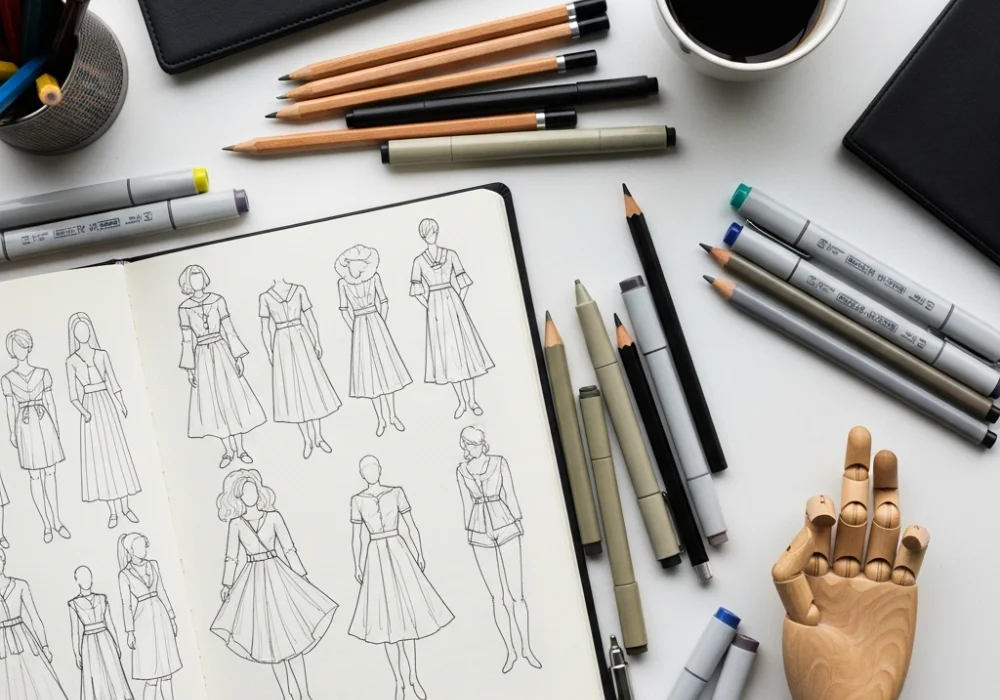
8. Stick Figure to Fashion Croquis
For those aiming for Fashion Design, the fashion croquis is your primary tool. A standard fashion croquis is 9 to 10 heads tall to give it an elongated, elegant look. However, for NIFT, you should also be comfortable with realistic human proportions.
The Exercise: Start with a ‘stick figure’ to determine the pose and balance. Add blocks for the torso and hips. Finally, flesh out the limbs. Practice drawing clothes on these figures, focusing on how fabric drapes over the body. Check our mock tests at myentrance.in for previous year questions on garment design!
9. Composition with Geometric Shapes
Aspirants are often asked to create a composition within a square or a circle using only geometric shapes to represent a concept like ‘Speed’, ‘Silence’, or ‘Chaos’. This tests your abstract thinking.
Spend 15 minutes a day taking a word and trying to represent it through lines and shapes. For example, ‘Conflict’ could be represented by sharp, jagged triangles pointing at each other. This exercise prepares you for the creative conceptualization questions that are weightage-heavy.
10. Narrative Storyboarding
A newer trend in design exams is asking for a storyboard or a comic strip. You might be asked to show the steps of ‘Making tea’ or ‘A day in the life of a postman’.
Practice breaking down a process into 4 to 6 frames. Each frame should have a clear composition, a logical flow of action, and should be easily understandable without excessive text. Focus on varying the camera angles—close-ups for emotions and wide shots for context.
Comparison: Sketching for CAT vs. Professional Rendering
Understanding the difference between quick exam sketching and slow professional rendering is vital for time management during the upcoming exams.
| Feature | NIFT CAT Sketching | Professional Design Rendering |
|---|---|---|
| Time Taken | 15 – 45 Minutes | 2 – 10 Hours |
| Medium | Dry colors, pencils, pens | Digital tools, markers, gouache |
| Primary Goal | Concept and Creativity | Visual Perfection and Detail |
| Evaluation | Observation and Intuition | Technical Accuracy and Finish |
Frequently Asked Questions (FAQs)
How many hours should I practice sketching daily for NIFT?
An ideal practice schedule is 2-3 hours daily. Spend 1 hour on technical exercises (perspective, shading) and 2 hours on conceptual questions and full-length mock tests from myentrance.in.
Is it necessary to use colors in the NIFT CAT?
Yes, most CAT questions specify the use of color. You should be proficient in pencil colors, water-soluble pencils, or markers. Mastering color theory—such as complementary and analogous colors—is a must.
Can I use a ruler or other drawing aids?
While rulers are generally allowed, design examiners prefer freehand sketches. Using a ruler for every line can make your drawing look rigid and lacks the artistic flair examiners look for.
Quick Knowledge Check
Test your understanding of these sketching principles!
1. Which perspective would you use to draw a bird flying over a city?
💡 Click to Reveal Answer
Three-Point Perspective (specifically the Bird’s Eye view).
2. How many ‘heads’ tall is a standard fashion croquis?
💡 Click to Reveal Answer
9 to 10 heads tall.
3. What is the benefit of blind contour drawing?
💡 Click to Reveal Answer
It improves hand-eye coordination and forces you to observe the actual details of an object rather than relying on mental symbols.
Ready to Ace your NIFT Entrance Exam?
Join thousands of successful aspirants who use myentrance.in for their preparation. Access high-quality mock tests, GAT study material, and design guidance designed for the current syllabus.
💬 Chat with our Experts on WhatsApp (+91 9526806124)




